Might & Magic: Heroes VII first impressions
We've decided to take a closer look at the latest installment of the legendary strategy series, created by Limbic Entertainment.
- Bonuses for flanking in battles!
- Non-linear campaign structure;
- Prettier and more varied maps (in spite of interactive objects sometimes merging with the embellishments);
- Changes in towns – mutually exclusive variants of buildings; lords and local garrisons;
- Return of classic magic (Mage Guilds in towns, traditional spell schools, etc.);
- Return of seven resources;
- More atmospheric soundtrack;
- A more traditional system of hero development...
- ... which, however, is too complex and overwhelming;
- Much uglier battle visuals;
- Uncompelling narrative in the campaign (no more cutscenes);
- Several ill-conceived interface solutions.
The last time I had to deal with Might & Magic: Heroes VII – about three and a half months ago – I prophesized that the developers from German studio Limbic Entertainment are in either for a sleepless quarter spent on patching up bugs or a several-months delay of release. As it turns out, I was probably wrong on both accounts. The launch planned for September hasn't been moved. It seems that Ubisoft preferred to spend some quality time on "crunching" and fight the bugs until the very last of them were squashed rather than postpone the release, but... Well, I don't know if it was just a matter of the developer’s inability to deal with all the errors on such short notice or its tardiness, but the truth is that in the newest version, bugs still abound. However, they are not the main topic of today's article. I am going to analyze the elements of Heroes VII to give a preliminary judgment on the individual parts, comparing them with their counterparts from previous installments of the series.
Narrative
The way the campaign was implemented in the tested game version is the biggest innovation as compared to the beta I played before, so allow me to start here. The main story arc of Heroes VII takes place ten years after the events of the fifth installment in the series. The Holy Empire has been torn by a civil war for decades, which led to the devastation of the entire land of Ashan. We learn about the conflict from the perspective of young Prince Ivan Griffin and his unique Shadow Council, consisting of representatives of six different groups: Haven, Academy, Necropolis, Stronghold, Dungeon and Sylvan. When we start the campaign, Ivan, weary of bloodshed, is just beginning to warm up to the idea of abandoning the battle for the throne of the Empire. His advisers unite against his resignation and come up with a brilliant idea, intended to keep the prince’s will to fight – each of them is going to share an inspiring story about their peoples.
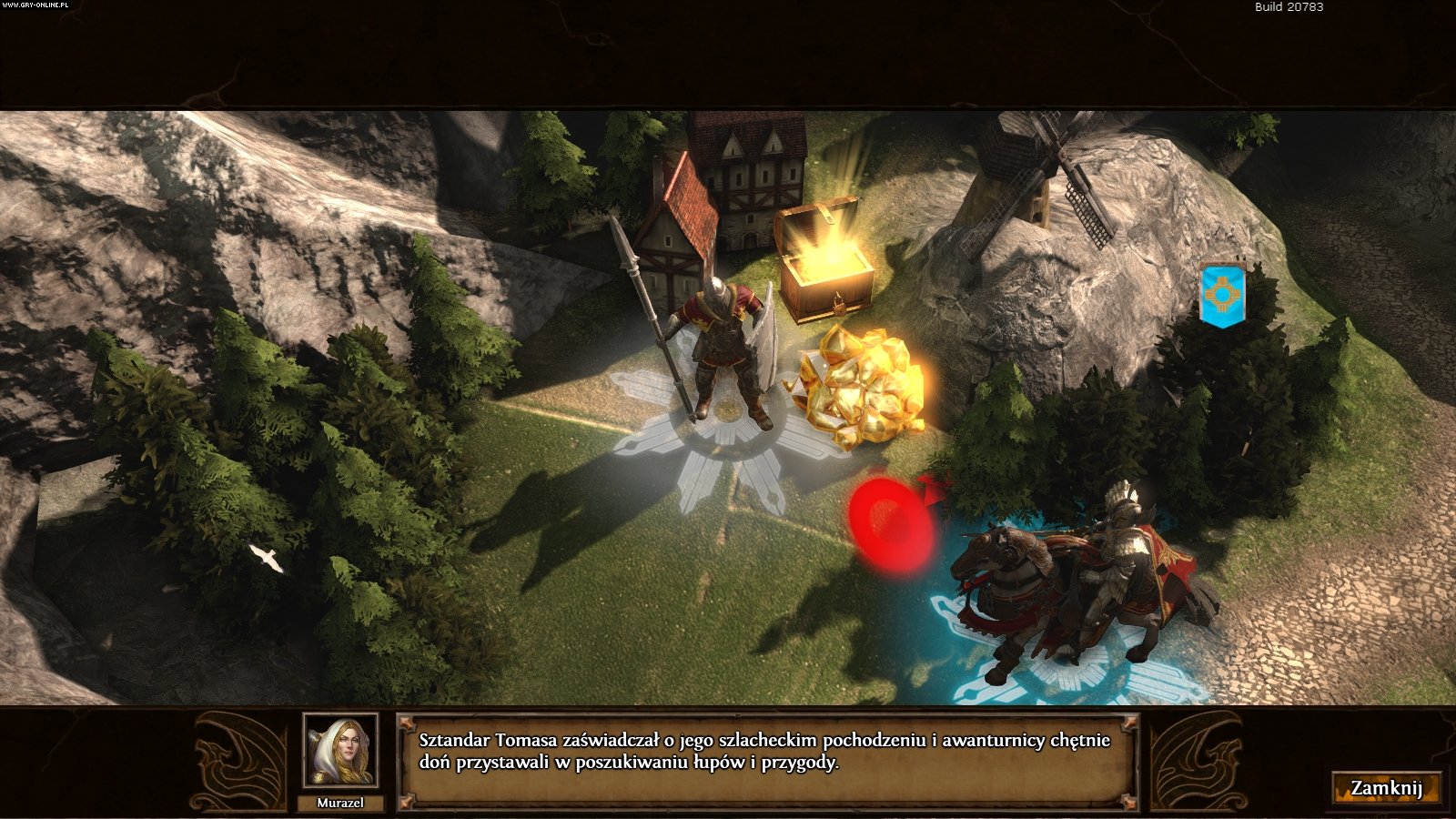
Cutscenes are also a means of narration, played out directly on the adventure map, and accompanied by the voiceover of one of the members of the Shadow Council. It’s a poor substitute for the cutscenes seen in the game’s predecessor.
As you might imagine, each of these stories is an individual campaign for each of the playable factions. They all consist of four missions, and we can play them in any order – nothing prevents us from jumping from one story to another. What’s more, from the outset the map of Ashan (as this is the form in which the menu of story mode was executed) shows the seventh campaign with two missions, focusing on Ivan and the decision he made upon hearing out his advisers. It the beginning it is of course blocked, but to gain access we have get to know only two stories. The developer has provided a decent amount of fun. Praise is also due to the nonlinearity – we don’t have to plough through all the story arcs if we want to quickly learn the fate of Ivan.
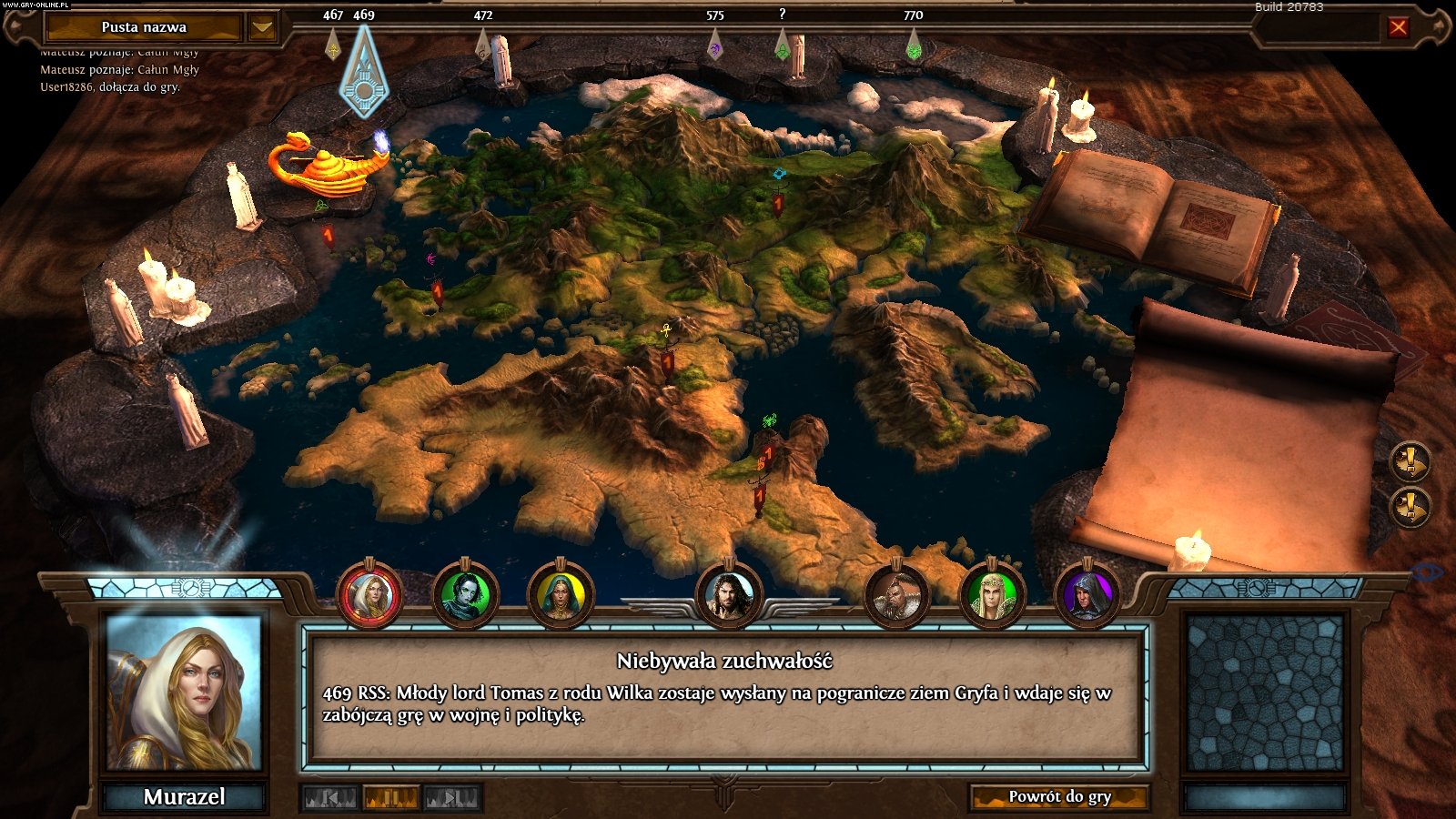
This is the campaign choice screen. What’s interesting, we can access it at any moment during gameplay, even though there’s not much to do here during missions.
However, I don’t have many good things to say about the way in which the whole story was presented. While the Shadow Council discussions are always accompanied by three-dimensional cutscenes, they only consist of... several static shots each. The characters resemble wax figures sitting at a table, where every few seconds the degree of mouth dilation changes, and sometimes the pose as well, while in the background we hear their lines (quite boring, might I add), and the camera moves rather slowly around the room. Unfortunately, the effect is poor. During missions we deal with a static narrative – meetings between heroes are accompanied, like in Heroes VI, only by windows with characters’ portraits, while their lines can be heard in the background. Much more interesting are the static three-dimensional scenes that are sometimes used to show a single event from the mission (eg. a sea voyage or a siege). They appear briefly, however, and represent a very small part of the applied means of narration.
Those who were hoping to see a further stage of evolution of the quite impressive cutscenes from the sixth installment will be sorely disappointed. In short, the narration looks as if someone wanted to do something that would pass as nice (mainly in promotional pictures and trailers) without consuming too many resources. In my opinion the end result is just poor.
Interface
Those who played Heroes V & VI will probably find their way in the interface of Heroes VII in a matter of seconds. True, all the elements look slightly different, and their location is not the same in every case, but you can see that there was no attempt to carry out a revolution where it was not needed. If anyone were to start the adventure with Heroes from the game number seven, they shouldn’t have any major problems in mastering the basics of the game. The interface is aesthetically made and clearly laid out, and what's more, most of its elements have easily understandable descriptions. In large part, the comfort of use stems from the fact that Limbic abandoned small windows known from the previous installment and replaced them with full-size screens.
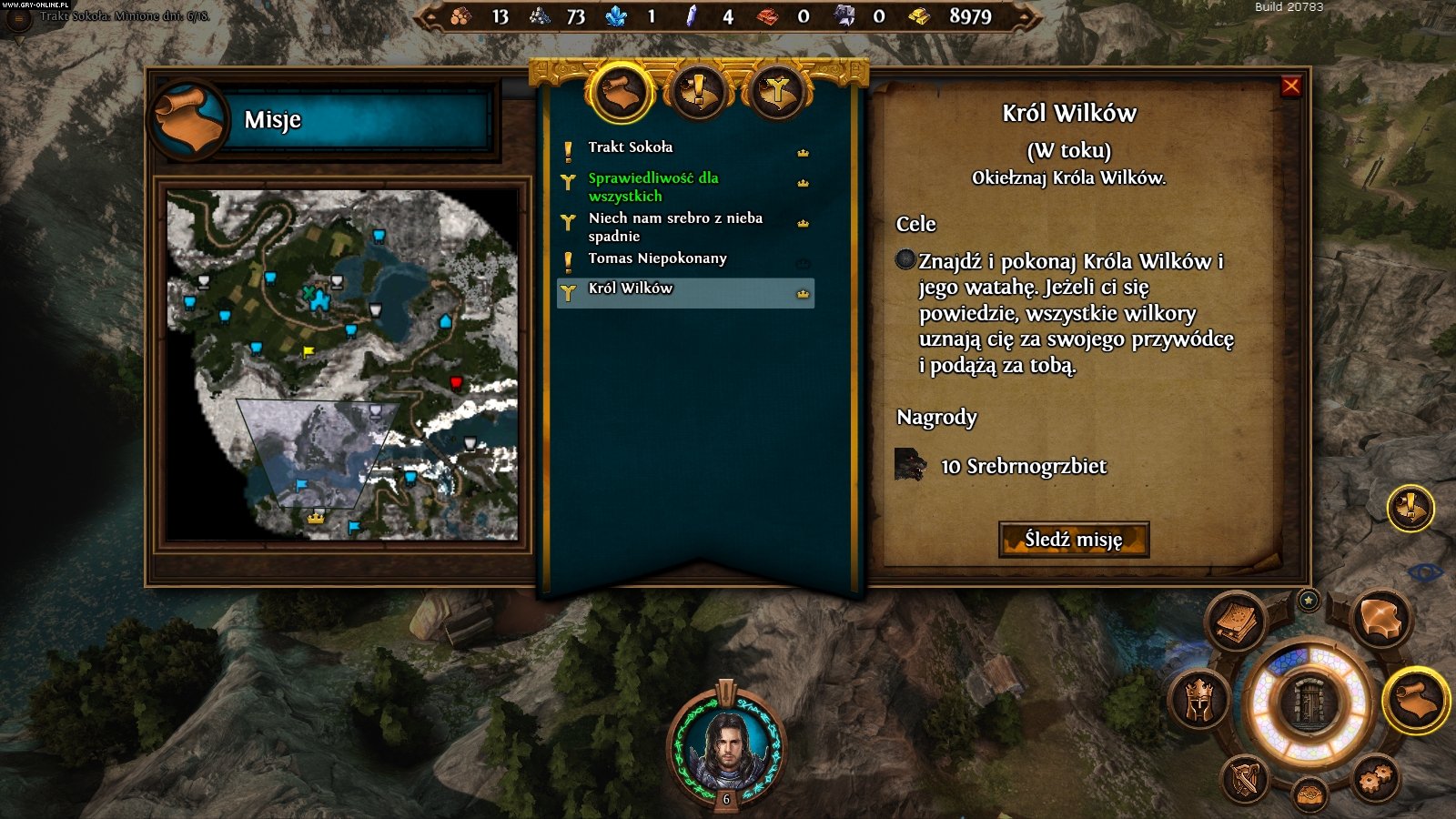
Although in Heroes VII there is no kingdom screen similar to the one known e.g. from Heroes III, it is substituted in a way by the minimap in the journal screen, which displays information about all the interesting points in the realm.
This does not mean, however, that the interface is perfect – the developer failed to avoid some silly mistakes. First of all, unit descriptions, or rather the lack thereof, are annoying. To see the special abilities of a given type of troops we must... fight a battle with it. Only during combat windows are displayed where we get to see descriptions of skills; otherwise we only see not overly suggestive, colorful icons. A little bothersome is the lack of options for managing our heroes from the city. Do you want to see all spells of your hero after a visit in the Mage Guild? You have to enter the adventure map to open the spellbook. To some extent, the interface is associated with the limit of the camera rotation angle to 90 degrees, which makes it difficult to browse interactive elements on the abovementioned adventure map.
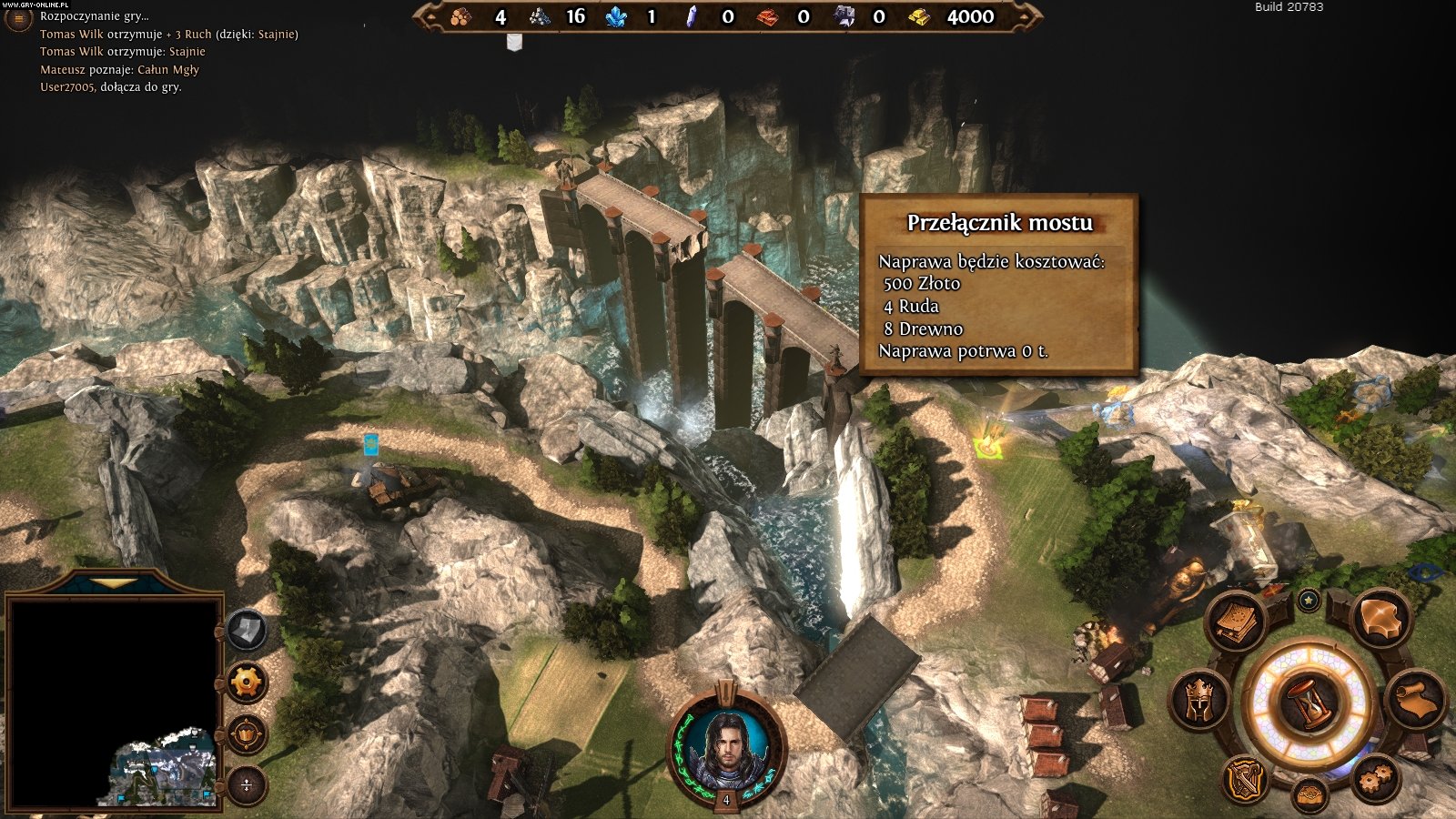
This is how the heralded „revolution” consisting in shaping the terrain on adventure map looks in practice.
Adventure map
At first glance, the exploration of the world has undergone major changes, but they basically boil down to the visual aspect. The way of moving around the map, and the objects we can interact with are essentially the same as in the previous installment. Even the spheres of influence and related rules concerning, e.g., mines, were kept. The impression of a revolution arises from the fact that objects were scaled. In the sixth installment we had a fairly realistic scale, with cities, trees, etc., towering over the hero, while in Heroes VII the proportions are disrupted. Now the hero is like a giant, well above the forests and buildings (especially those that are for decorative purposes only). Thus, the appearance of the world has become closer in some ways to what we saw in Heroes of Might & Magic III. On the other hand, peppering the map with decorations sometimes makes it difficult to spot interactive elements (eg. camps, treasure chests), especially with the aforementioned artificial limit of the camera movement.
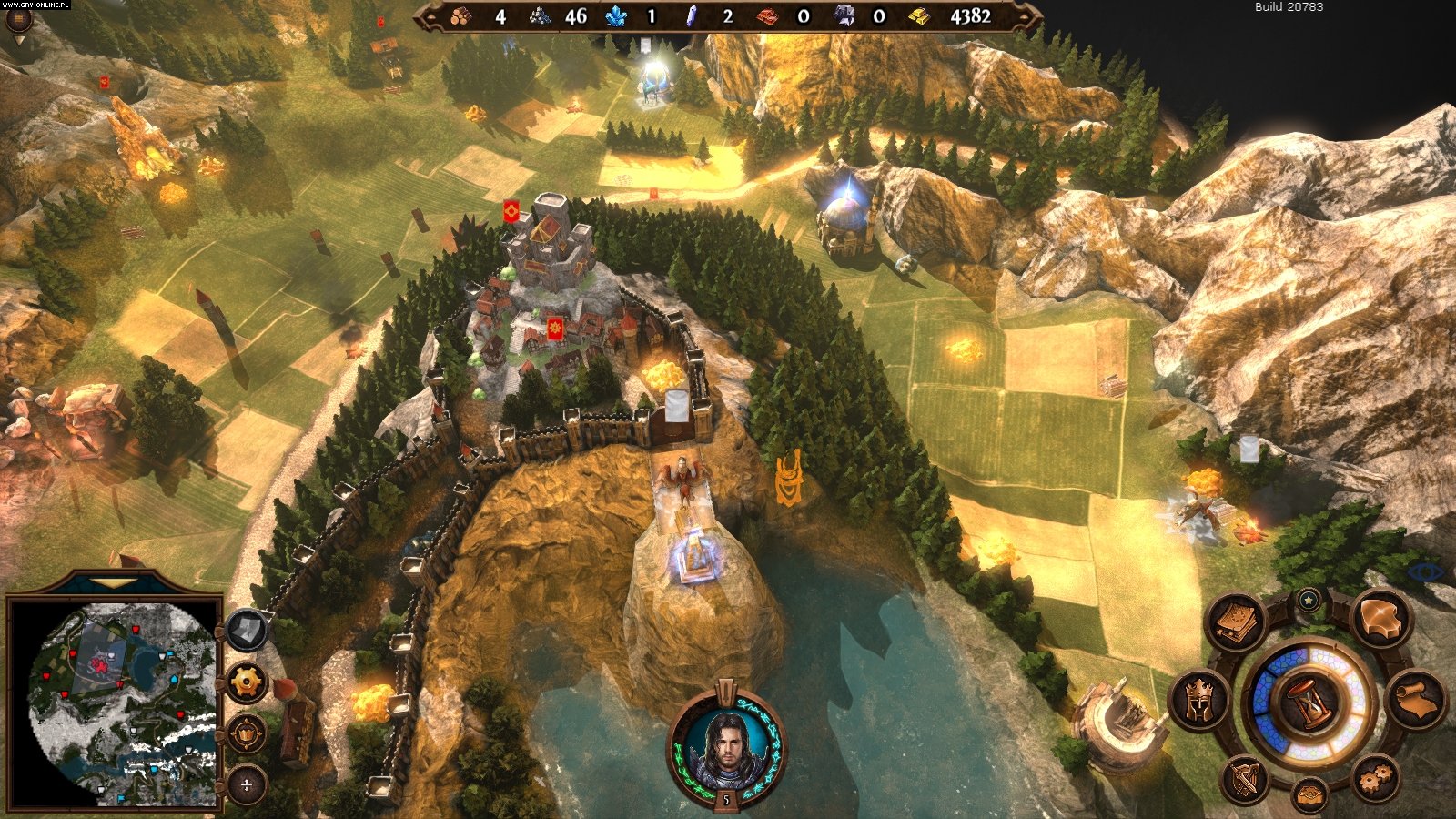
Even though the quality of models and textures on the adventure map of Heroes VII is not substantially better that that of its predecessor it makes a better impression thanks to light effects and changed proportions between objects.
Despite all this, I consider the visual changes to be positive – thanks to them, the exploration of the world has become more enjoyable than ever before, and discovering the map is sometimes also rewarded with magnificent landscapes. The latter was helped by the fact that in the seventh installment the visited realms were given a more varied terrain, as promised by the authors. As for the other change the announcement of which was accompanied by quite some hype, namely adding the ability to transform the environment e.g. by the construction of bridges and knocking down dams, this supposed revolution somehow failed to reveal itself. It is true that at the beginning of the Haven campaign I came across a "switch" with which I had to rebuild a bridge for a certain amount of wood, ore and gold, but it's hardly a breakthrough, more like a fun tidbit for a player looking for tactical accomplishment, or even a visual pleasure.
Battles
Among the elements that were lacking in the sixth Heroes and were restored by Limbic in Heroes VII are the siege engines (here called "special units"). Interestingly, the developer did not simply throw catapults, ballistas and first aid tents back into the game. Instead, the creators decided to give each faction an individual special unit. For example, instead of a catapult the Stronghold has tamed Cyclops at its disposal.
No different than before is the element in which a veteran of the previous installment will find their way easily. This doesn’t mean there are no changes – on the contrary, it is in the battle system that an innovation was applied which I will miss the most when I reach for one of the older Heroes. I'm talking about bonuses to damage for attacking units from the side and rear. This is not a modernization that turns the mechanics upside down (if someone finds it annoying, it can be ignored), and it adds a lot of depth to the fighting. Those who prefer a little bit of ingenuity in the battles rather than letting the troops go straight at the enemy won’t be bored with the skirmishes in the seventh installment.

Without a doubt, battle arenas are appealing and diverse. As for "spectacular close-ups" on the fighting units, unfortunately they are only spectacular by name.
However, since there is a big step forward, there also has to be a step back. Or at least that's the assumption the developer probably came up with, tinkering with the visuals of battles. While the appearance of the arenas can still demonstrate some progress, the way movements of units or the effects of spells look made me rub my eyes in disbelief. Animations don’t work well together, they lack smooth transitions, sometimes the transitions are even omitted (e.g. a counterattack not proceeded by a visible hit). In terms of aesthetics of battles Heroes VII could be pitted against the fifth installment... and not come out victorious, even despite the undeniably more detailed models.
Towns
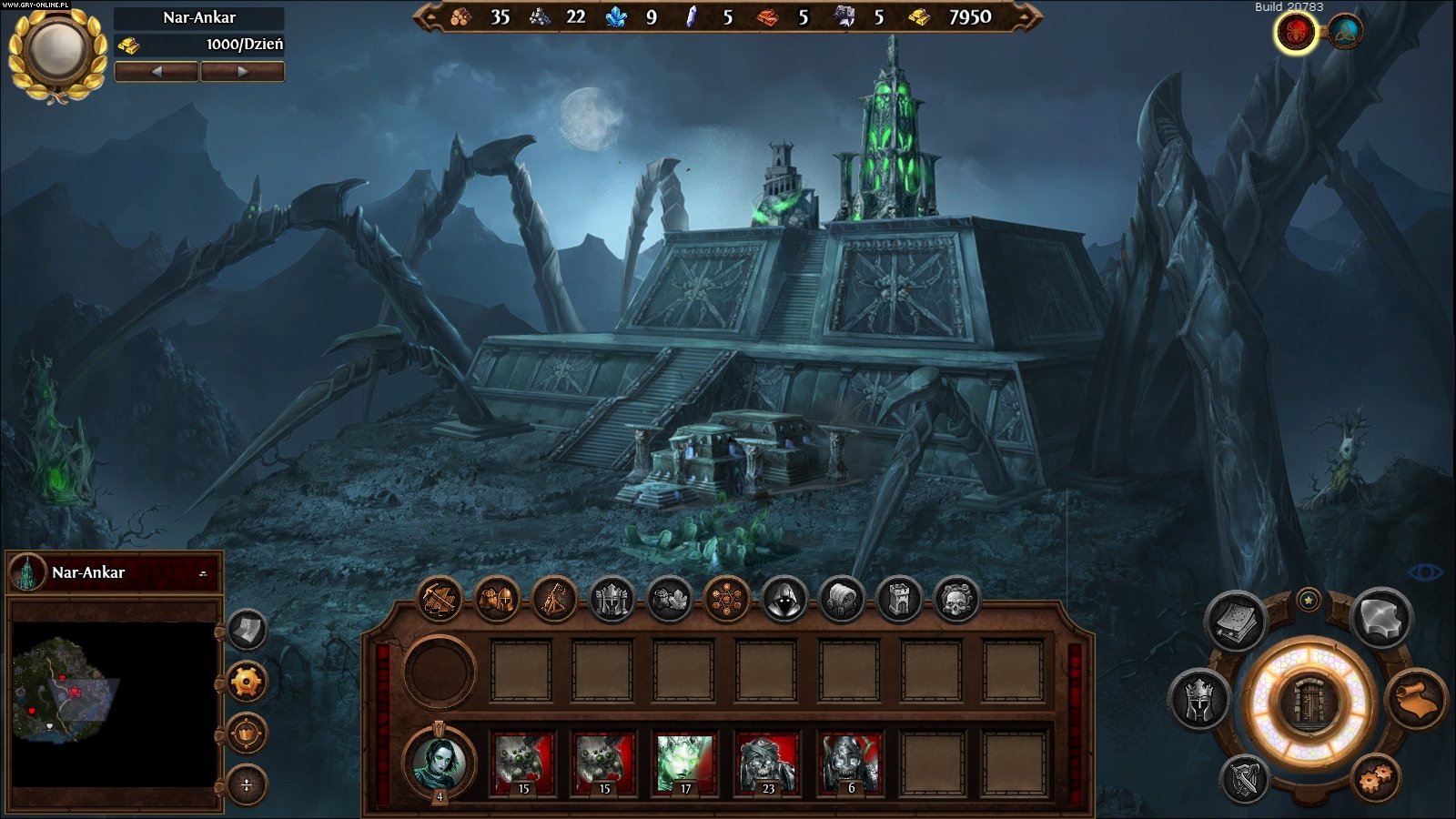
If architecture theorists were to assess Heroes VII, I would suggest the name "arachnomesopotamian” to describe the style of Necropolis.
Since studio Black Hole messed up the appearance of town in Heroes VI, Limbic Entertainment decided not to tinker with this aspect and use proven solutions. Therefore once again we received hand-drawn, two-dimensional castle screens – aesthetically made and atmospheric, but in my opinion fairly modest (not to say: cheap) as compared to the three-dimensional splendor that the fifth game in the series offered. I realize that the solution used in Heroes of Might & Magic V has as many supporters as it has opponents, so I will not dwell on the subject any longer – I would gladly see a further evolution of this element myself (only not in the direction as idiotic as the one originally featured in game number six), but staying true to the tradition can hardly be seen as a disadvantage.
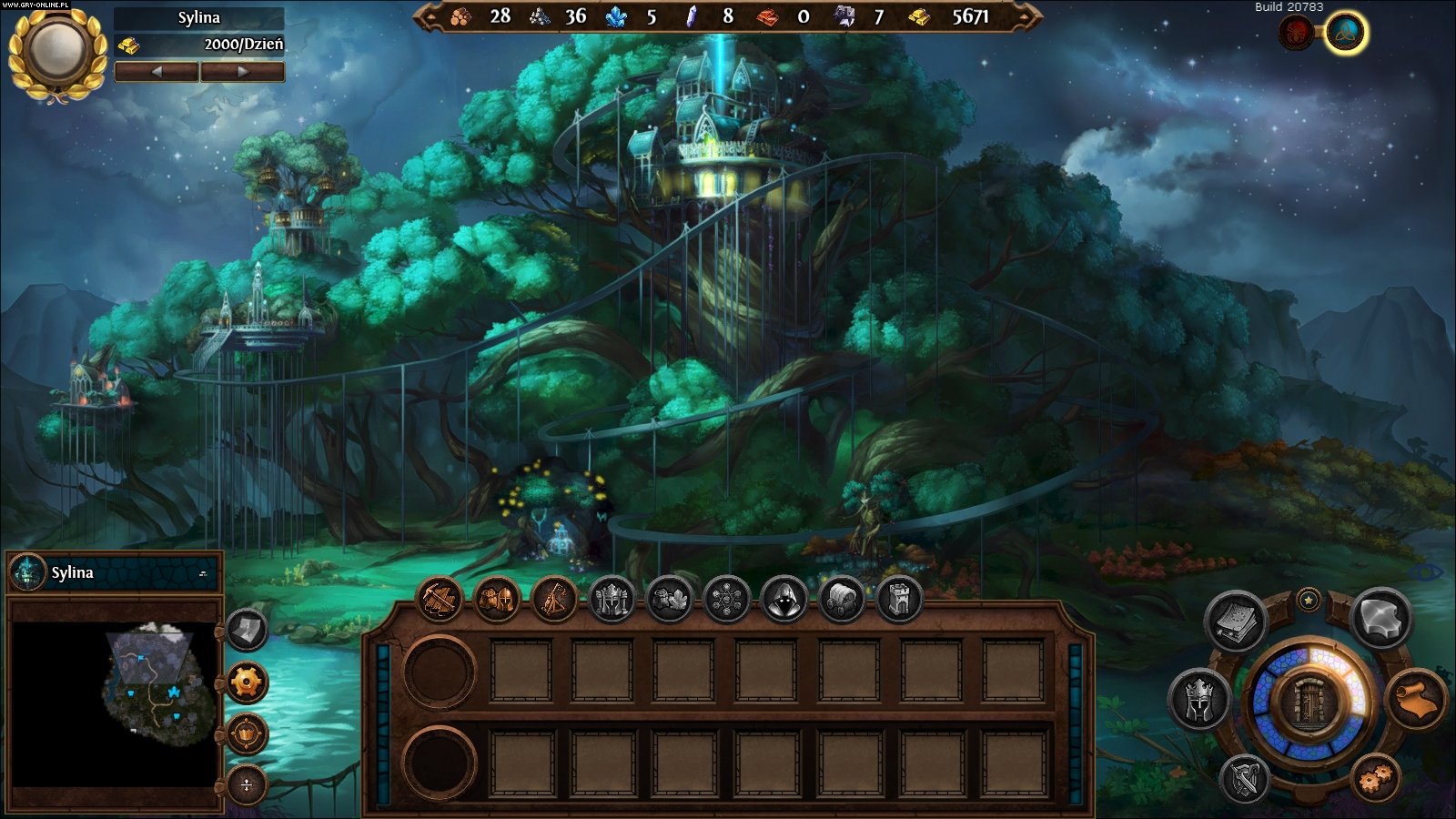
Elves, as always, are partial to trees.
Luckily, the developer decided to be more experimental with the way castles function. First of all, the position of a "lord" known from Heroes IV made a comeback, this time with more options at their disposal. The hero who holds this position can have many interesting effects on the town and its surrounding sphere of influence. Everything depends on the abilities acquired – and quite a few of those have been placed on different skill trees in the character development plan. Recruiting heroes in order to specialize them in town management may even be a refreshing form of playing if someone wants to delve a little deeper into the strategic side of things. It's similar with the alternative versions of buildings, which is another element taken from Heroes of Might & Magic IV. We choose between 'lairs" of seventh-level units, troops that are to receive a bonus to weekly birth rate, types of resources generated, or passive bonuses for spheres of influence of a given town.
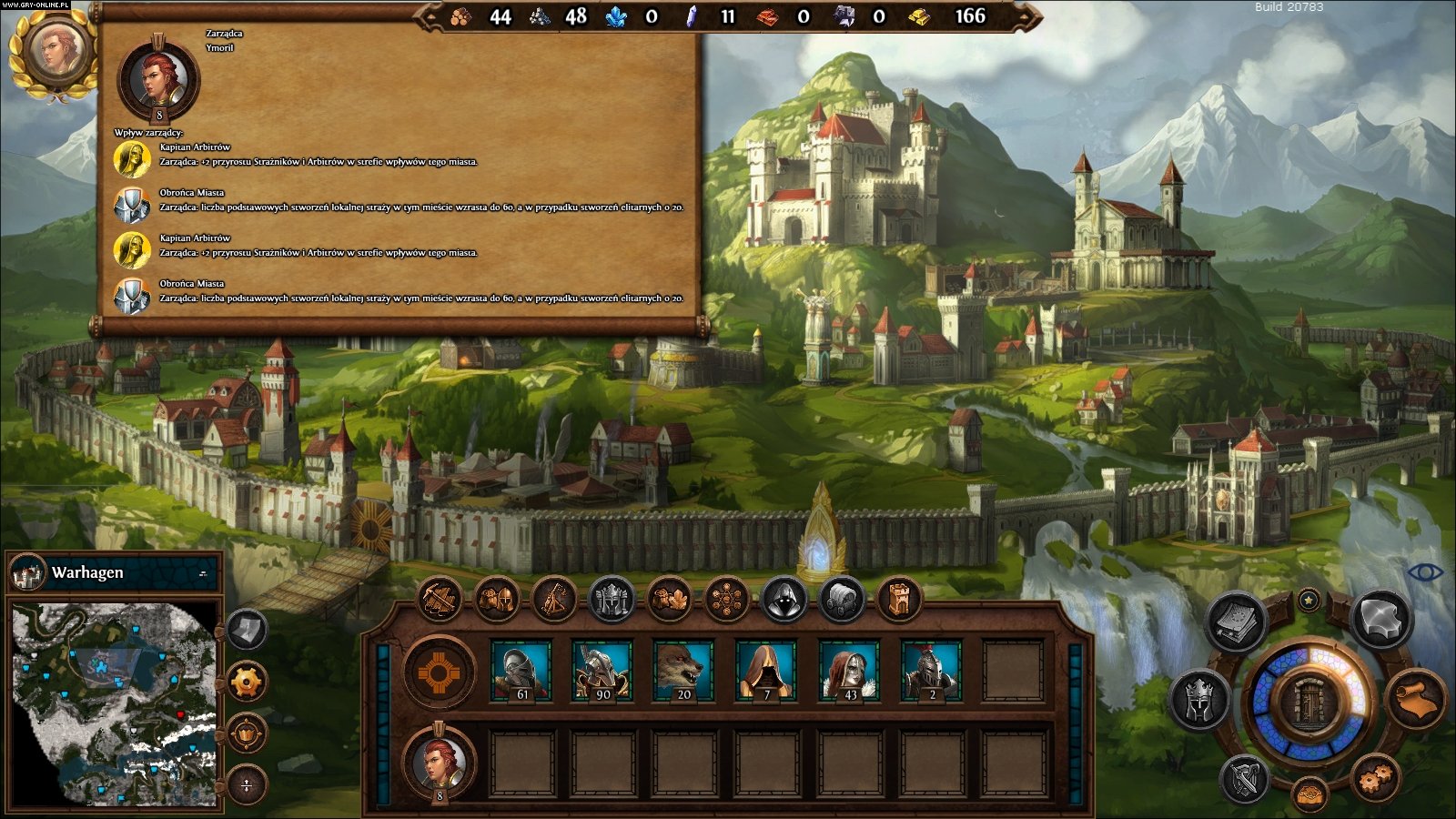
As you can see, a well-developed hero occupying the position of lord can do a lot of good for their town.
It's also nice to see the return to seven resources (instead of four as in the sixth installment) and the restoration of the Mage Guild in its classic form, along with more traditional division of schools of spells. In addition, Heroes VII simplified the issue of town defense. We no longer have to leave many units in town to have a way of defending ourselves in the event of an unexpected siege, because the development of fortifications is provided by a "local garrison" – troops whose sole purpose is to defend the castle. The more defensive structures we build, the better and more numerous units we will find in the garrison. As for the newly introduced elements that seem botched, I would count the demolition option among them. It works on all the buildings of a specified level at the same time and doesn’t even guarantee the return of lost raw materials, so it is better to correct errors in town development using classical methods – loading an earlier saved game.
MUSIC
Although on the occasion of the previous beta test of Might & Magic: Heroes VII I found the soundtrack of the game not very original, after spending some time with it I have to admit that perhaps I was wrong. Over the hours, the music – inevitably repeated again and again – not only failed to bother me, but even managed to last in my memory. In short, the musical pieces used in the seventh installment don't bring shame to the musical heritage of the classic Heroes.
Heroes
In this respect the developer also decided to remain faithful to the sacred tradition – which will grant them the gratitude of many players for getting rid of the mechanics of blood and tears, dynastic options, and other such frills, while not quite abandoning new additions. The latter can be seen primarily in the development of characters – yes, this is about these majestic and somewhat frightening wheel systems. There, we can find skill trees whose construction and nature in general are close to that which we know from the previous versions. We therefore have a division into basic, expert and master level of abilities, such as economy, leadership, art of war or particular schools of magic, and minor "perks" within each level. The problem consists in the fact that all this is available for the player from the beginning of the game – and we are talking about 10 skill trees per character. With each level the hero gets 1 point that can be allocated to anything visible on the screen.
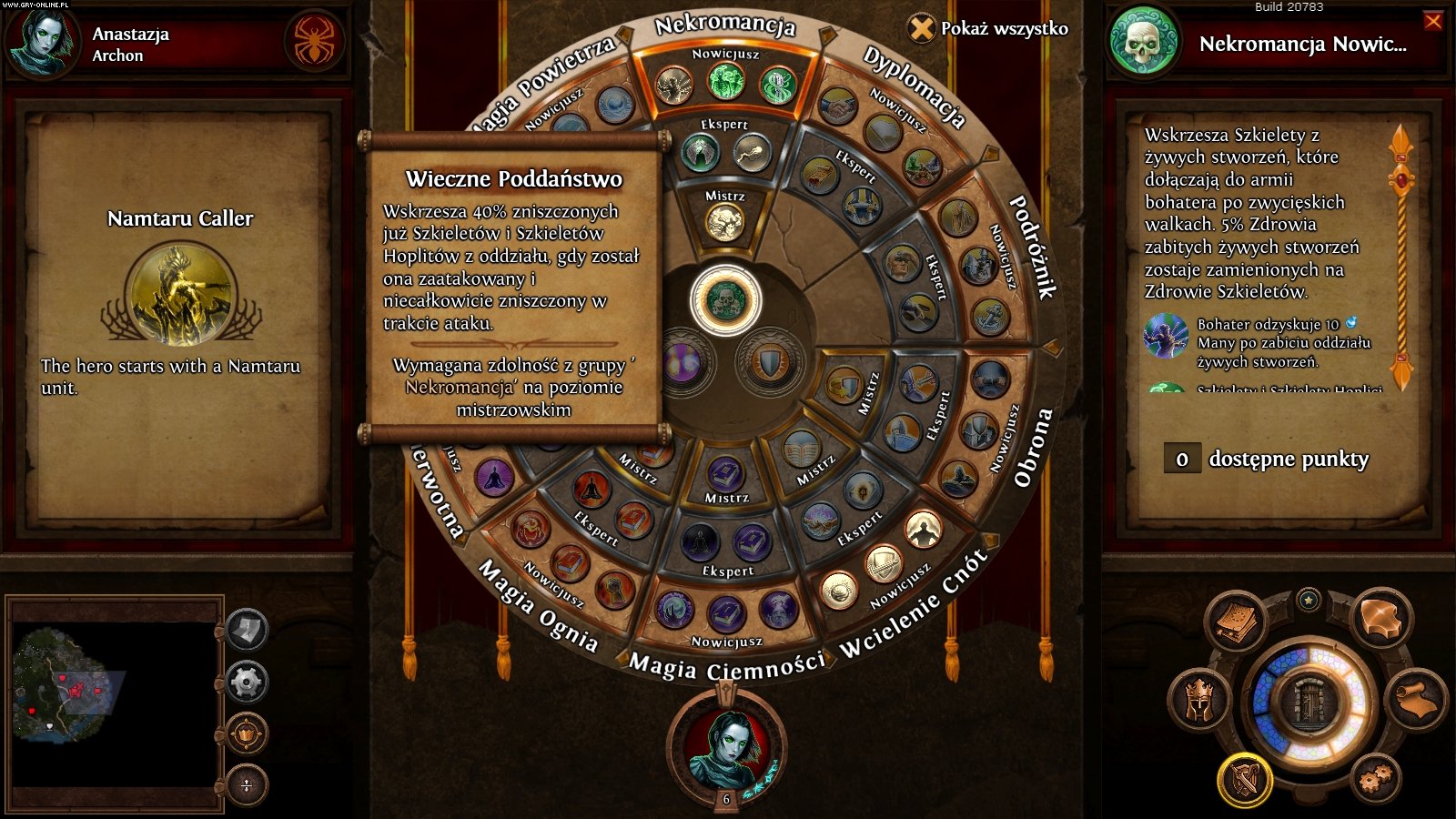
Respect, delight, and awe – one "little" character development system, and so many emotions. Among its disadvantages we can count the fact that due to the colors chosen for "perks" it’s hard to distinguish what is chosen and what is not.
More advanced players will probably not be disturbed by such a solution – perhaps even on the contrary, they will appreciate the fact that they were allowed to personally plan the development of the hero from beginning to end, and are not forced to accept a random selection of skills to develop with each level-up. However, novice players will probably spend the first hours of the game scratching their heads, analyzing dozens of skills and wondering every level what to buy next. I must admit that while "perks" were rather to my liking (and many of them demonstrate the authors' ingenuity), every level-up was accompanied with a moan: "Geez, I have to choose a skill agaaaaain". Imagine that you have two or more developing characters. Or that you play in multiplayer mode. Do you realize now how time-consuming this may be? Although the skill system has been beautifully drawn and quite clearly described, I miss the way it was in Heroes III, IV and V. I also miss the heroes' biographies – in Heroes VII the only elements that set them apart are individual portraits and old-school special abilities.
Recap – one step forward, one step back?
As I mentioned before, continuing the evolution of Might & Magic: Heroes is a great challenge – one step to the side too far and you run the risk of being lynched by die-hard fans, one step too close and you are dubbed a cautious conservative. How does this "dance" look like in the case of Heroes VII? In my opinion Limbic Entertainment has leaned towards the more conservative approach. At this point one might probably ask: "Then tell us what you would change, smartass?" My answer is: nothing. At least I wouldn’t suggest any major changes in the mechanics of the game; at most a return to a less complex character development system, light rearrangement of the interface and other such details. The formula of this series has been established for years, and any attempts to reinvent the wheel are misguided concepts. I believe that successive Heroes simply have to be conservative to a large extent to stay true to their name. Those who want a revolution should choose another title.

The adventure map looks far less spectacular in sandy areas than in does in meadows and fields.
But this only applies to gameplay mechanics – the rest should forcibly resist the passage of time. When the fifth installment was released, many fans of the series where lamenting, terrified of jumping in full three dimensions. Still, Heroes of Might & Magic V was eventually accepted and now many players consider it to be on par with the absolute cult classic that is the third installment. Of course, today there is no room for such graphic breakthroughs as those that took place almost ten years ago, but this does not justify standing still. Two-dimensional town screens look nice, but for how long can one hold on to them? The battles are no longer a sight to behold like they were in 2006. The Total War series shows that strategy games can use graphics to quicken our pulse, whereas Heroes still cling to a rigid system with a few animations for unit.. Long story short, the series provides no delightful sights. What's more, there are still those ugly static cutscenes – a big step backwards as compared to Heroes number six. Of course, visuals are probably the last thing that should define a strategy production, but since the gameplay mechanics don’t give much room for upgrades, they could be at least adorned with more eye-catching elements.
All that glitters is not gold
When I tested Heroes VII in June, I praised the overall "heroes-ness" of the game, and turned a blind eye to the errors, saying to myself: "This is just a beta, the release is still far away, and by September they will definitely get rid of the most glaring shortcomings". Several, perhaps the most disturbing, imperfections were eliminated, but does it matter since the game is still rife with errors? Don't get me wrong – I am still convinced that Limbic’s game will be an instant hit and tons of people will buy it. I am not convinced, however, if the assessment – from both gamers and critics – will be as optimistic as the sales. The decision to withdraw from the controversial "revolution" proposed in the previous installment and use the popular and known solutions can hardly be called a mistake, but at the same time with relatively little value added in Heroes VII and with its visual standstill it's hard to talk about a full-fledged sequel. Replacing Heroes of Might & Magic V and Might & Magic: Heroes VI with Heroes VII makes me think of dumping one girl for another with almost identical personality, who can tell us stories we haven't heard before, has hair of a different color and is seemingly a little bit prettier. True, life thus becomes a bit more colorful, but is it worth paying such a high price?
