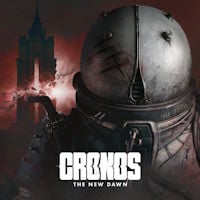
Cronos: The New Dawn review - great atmosphere that is rough around the edges
Although Cronos: The New Dawn doesn't revolutionize the genre, fans of survival horror games set in unique settings will be satisfied. A dense atmosphere, a mysterious plot, and a solid dose of anxiety define this new game from Bloober Team.
The review is based on the PC version. It's also relevant to PS5, XSX, NS2 version(s).

For years, Bloober Team has taken us on journeys to the darkest corners of the human psyche. From cyberpunk nightmares in Observer, through eerie forests in Blair Witch, to the dual reality of The Medium, developers from Krakow have made a name for themselves as creators of atmospheric, narrative-driven horrors. However, it is Cronos: The New Dawn, their latest work, that deserves to be called their best and most complete original IP. This is a game that, on one hand, pays tribute to the golden years of the genre, evoking the claustrophobic horror of classics like Dead Space, and on the other, it builds its own unique identity on a foundation that for many is both familiar and terrifying, and for others, unusual and mysterious.
However, Cronos is not a revolution. It doesn't reinvent survival horror rules. Instead, it focuses on what's most important in this genre - atmosphere, mystery, and a sense of entrapment. This is a story that draws you in not because of revolutionary mechanics (although the developers clearly tried to make it so), but thanks to a fantastically realized world, which is set in post-apocalyptic Poland. And it is precisely this element that makes Cronos: The New Dawn such a fresh experience and, most importantly, memorable.
Poland after the end of the world
The action takes us to New Dawn, a fallen metropolis, where the harsh concrete and monumental, communist-era architecture are a clear reference to Krakow's Nowa Huta district. This is Poland after a mysterious apocalypse - a devastated, silent and dangerous world. We step into the role of the enigmatic Traveler, whose mission is to discover the truth about the cataclysm that plunged the world into chaos. Her tool is time rifts, anomalies that allow her to travel back to the past, to the days when the apocalypse was just starting. The goal is simple, but extremely risky - to "extract" key figures, whose memories and knowledge can shed light on the causes of the disaster.
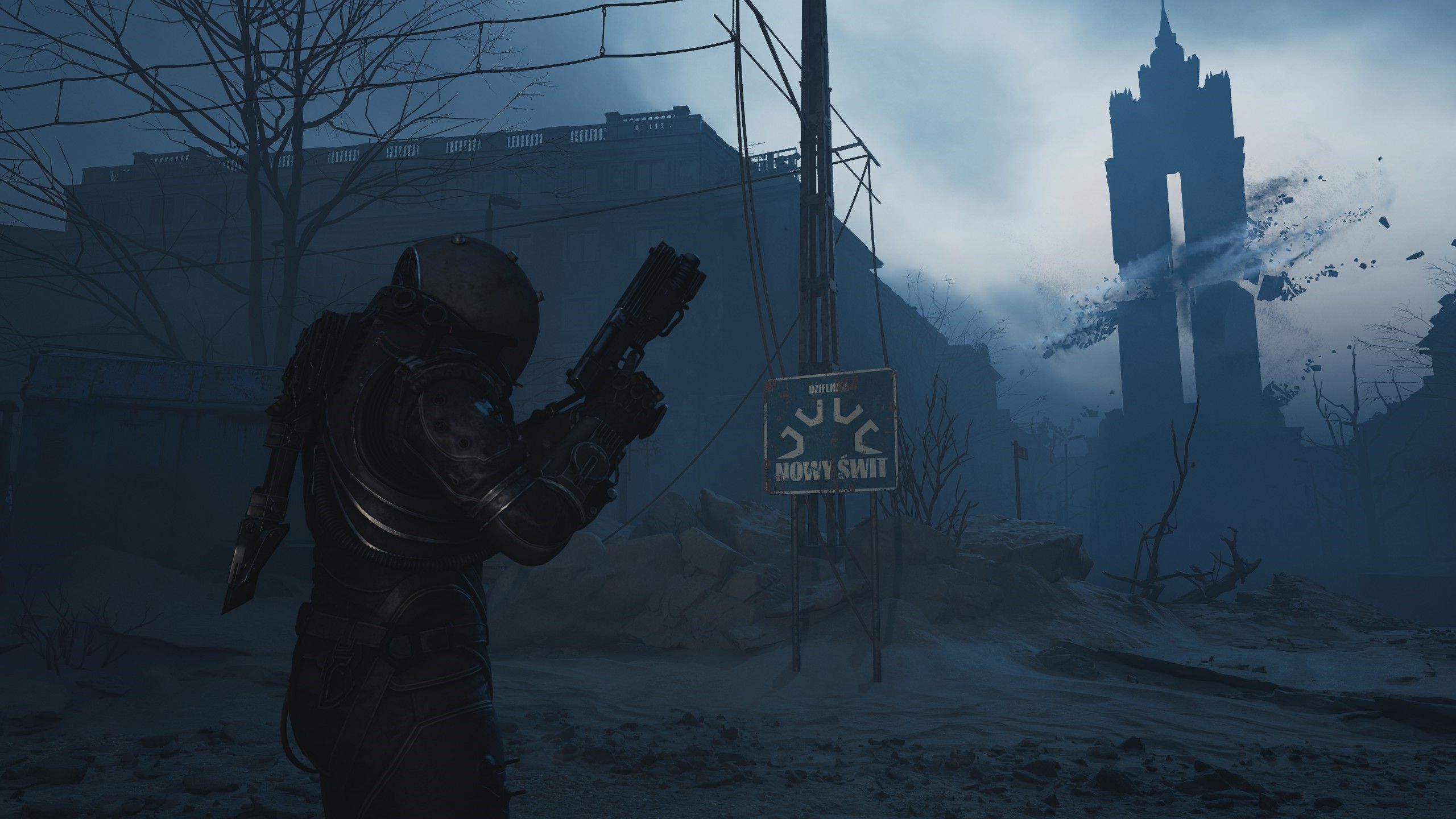
For some, the setting will be very familiar, for others, quite unusual.Cronos: The New Dawn, Bloober Team, 2025
The world presented in the game is the absolute greatest strength of Cronos. We explore destroyed Polish estates from the times of the Polish People's Republic, abandoned hospitals and apartments in large-panel blocks, and each step intensifies the feeling of unsettling familiarity. The developers, with great attention to detail, recreated the old realities, which for a player familiar with them in real life, will be strikingly authentic. For others, however, they may be disturbingly interesting. On the walls, we find Polish posters, warning signs and announcements, and in the abandoned apartments, we come across everyday items that look as if they were taken straight out of old Polish homes. This method, called by the developers the "legacy of post-communism", works phenomenally. Horror becomes more tangible when its backdrop is not an anonymous town, but a perfectly familiar, homely landscape.
Such a brilliantly realized world is not just a background - it's a stage for an equally engaging story. The plot in Cronos is dark, mysterious, and sometimes surprisingly philosophical. However, it starts with complete informational chaos. We know what we have to do, but we have no idea why. With each passing hour, the game reveals more information, feeding our curiosity and allowing us to piece together elements of the puzzle into a coherent whole. Most importantly, the script is masterfully constructed - each answer creates two new questions. When we find out what happened, we start asking who was behind it. When we get to know the perpetrators, we question their motives. This structure, reminiscent of peeling an onion layer by layer, makes the engagement in the story constantly grow, and we feel like real detectives on the trail of an unpleasant truth.
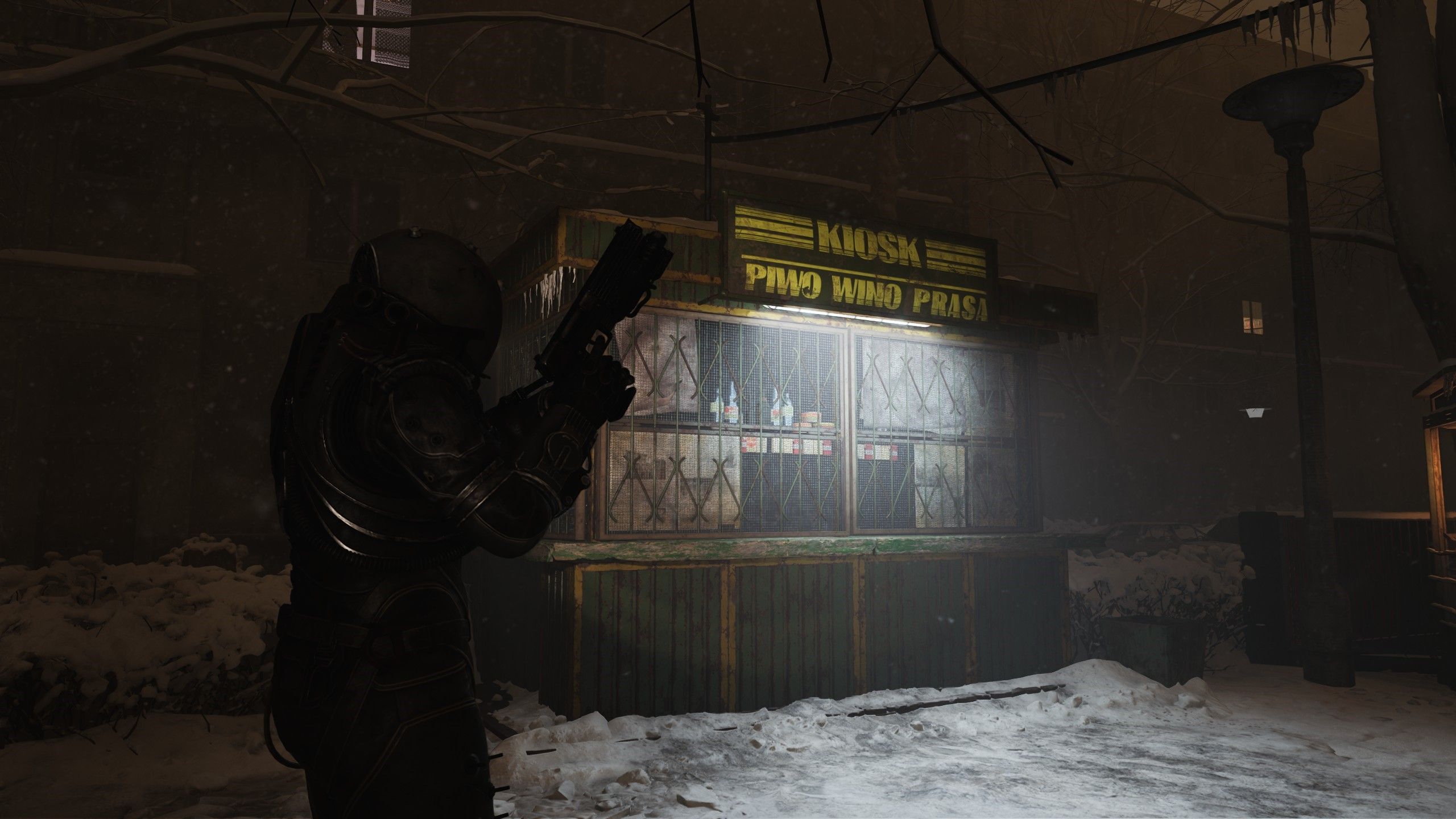
During the game, you will often wonder what it's all about.Cronos: The New Dawn, Bloober Team, 2025
This dense atmosphere is also consistently built by masterful sound design. Cronos often scares not with what we see, but with what we hear - a distant metallic grind, a sudden whisper in our head, or a loud bang from behind the door. The whole is enhanced by a brilliantly composed soundtrack - the music seems to be perfectly matched individually to each scene. Each location also tells its own, quiet story through environmental narration. Dried blood stains, overturned furniture, an unfinished game of chess - these silent scenes build an image of tragedy much more effectively than any exposition. This is complemented by found notes - written and voice - which are fragments of the lives of people surprised by the apocalypse, adding depth and human aspect to the world. Regarding the latter, the most important thing is that the developers apparently found a happy medium in their placement and creation - I practically did not have the feeling that any note is too long or unnecessary, which in this type of game, contrary to appearances, is easy to overdo.
The next paragraph contains a minor plot spoiler regarding time jumps. It is not significant and you will discover it yourself within the first two hours of gameplay, but I prefer to warn you anyway.
However, the biggest disappointment comes from the key plot mechanic of jumping back in time. The potential was enormous - the opportunity to see Poland just before the apocalypse, to observe how our actions in the past affect the present. Unfortunately, the game only takes us back to the moment when the cataclysm is already beginning. As a result, apart from the appearance of a few key human characters for the plot, we get the impression that not much has changed. We are still fighting the same monsters in an almost identically destroyed environment. This makes the time jump seem more like a cosmetic change of scenery than a fundamental gameplay mechanic, but it should be noted here - this usually has a significant impact on the plot.
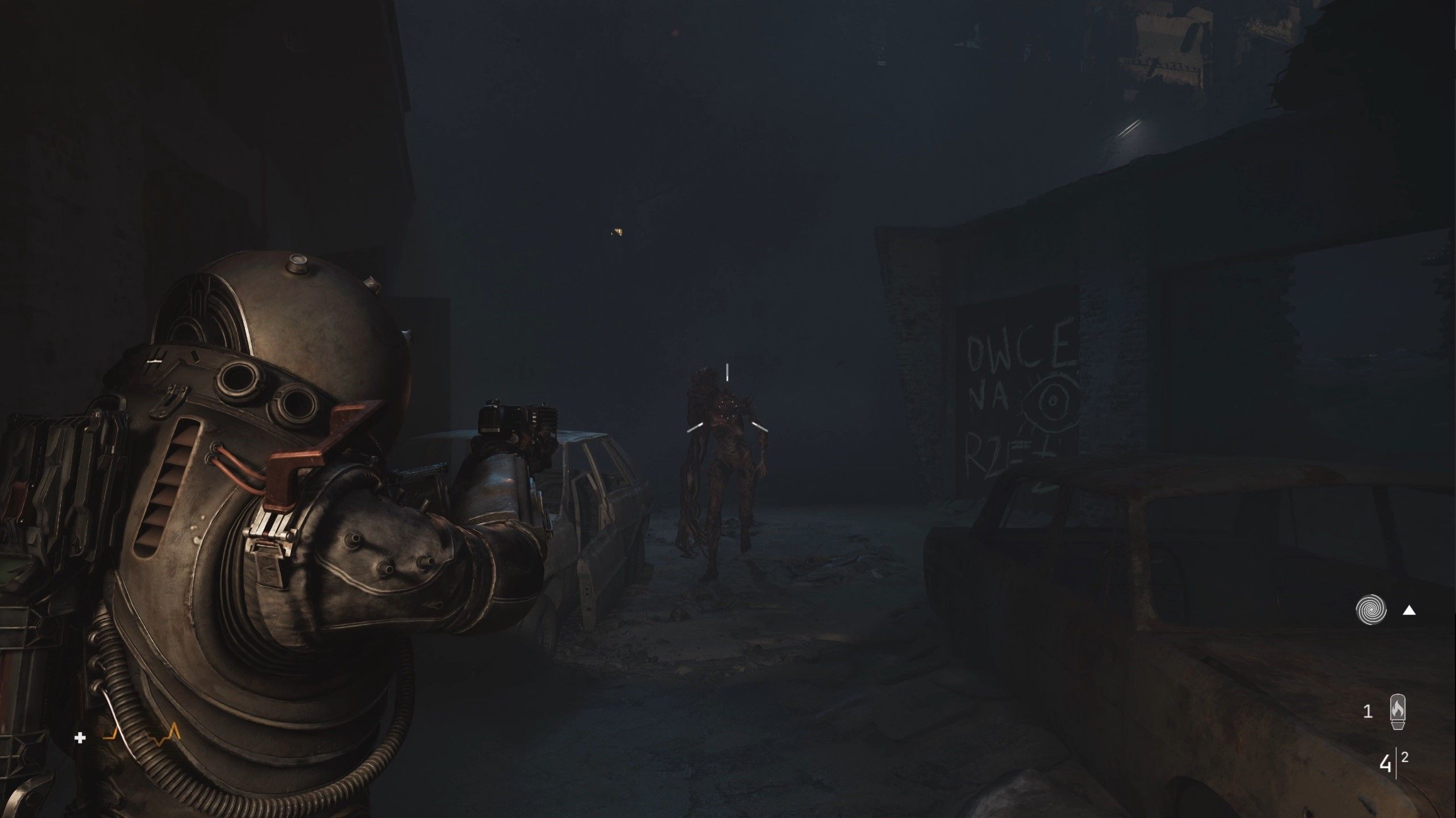
I would like a bit more from jumps into the past.Cronos: The New Dawn, Bloober Team, 2025
Gameplay – solid foundations and untapped potential
The core gameplay in Cronos is based on the classic survival horror loop - exploring claustrophobic corridors, managing limited resources, solving simple environmental puzzles, and, of course, fighting for survival.
The combat system is an example of fascinating contrasts. On one hand, on a purely technical level, the shooting itself is executed excellently. Gunplay gives immense satisfaction - each weapon has its own weight, the reloading and recoil animations are smooth, and enemies react to shots. A simple yet effective upgrade system allows you to modify the arsenal, and each invested part makes the weapon noticeably more powerful. You can feel that the developers have done their homework and understood what makes virtual shooting simply enjoyable.
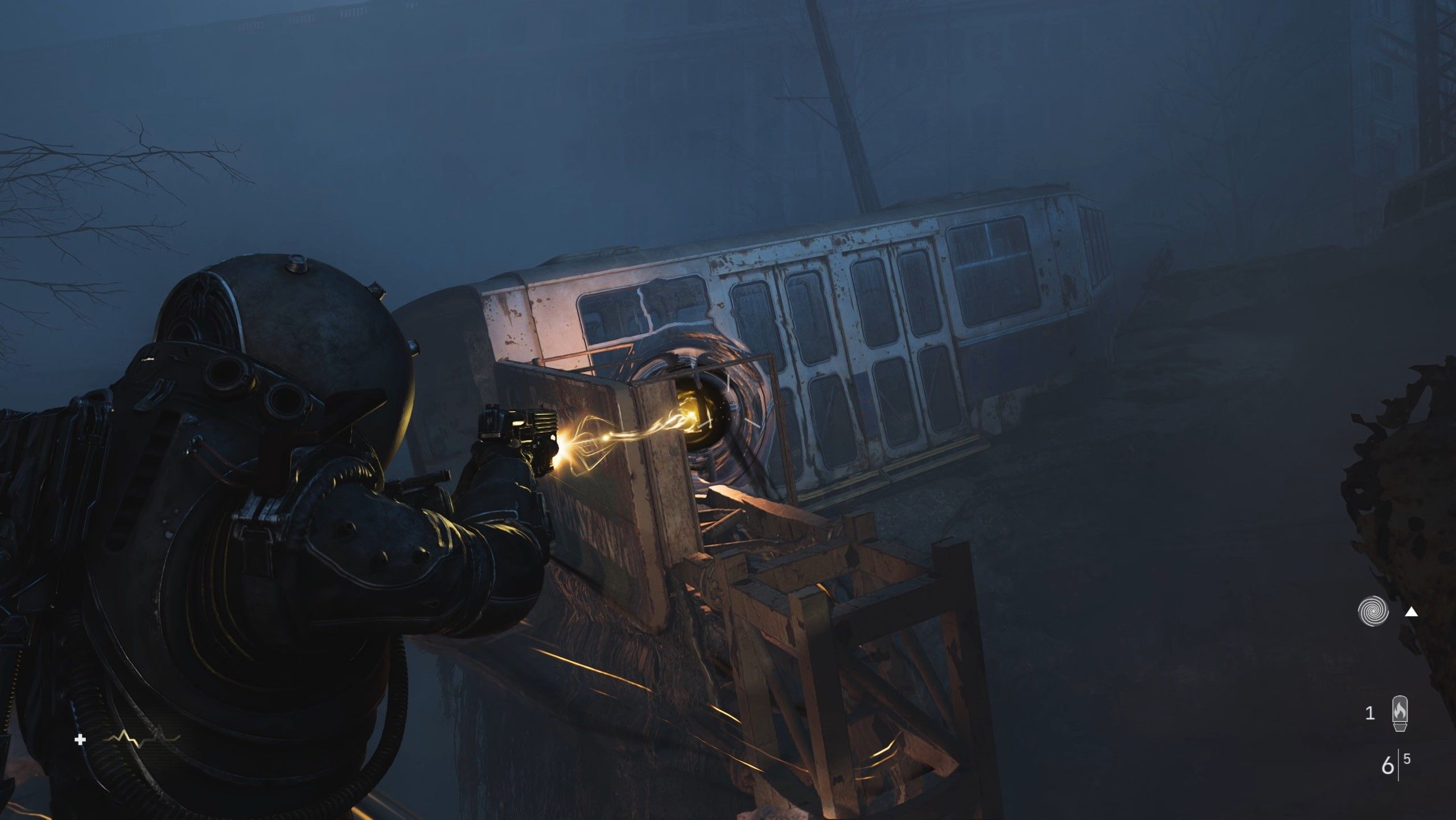
Shooting is satisfying, but it can become schematic.Cronos: The New Dawn, Bloober Team, 2025
Unfortunately, the mechanic clashes with being painfully schematic. While fights with basic enemies can be exciting, bosses and larger opponents almost always boil down to the same, repetitive tactic: find an explosive element in the environment (a barrel, a gas cylinder), shoot at it, and when the enemy is stunned, attack their weak point. This pattern repeats itself so often that clashes, which should be the culmination of tension, quickly become predictable and a boring duty.
The balance doesn't help either. Close combat is so difficult, risky, and ineffective that it is only a last resort when we run out of ammunition. The game clearly favors powerful, charged shots from certain weapons, which can neutralize the threat before it even gets close to us. All this makes the player quickly find the optimal strategy and they rarely have reasons to deviate from it.
The biggest disappointment, however, is the enemy merging system, which sounded intriguing on paper. The ability of enemies to absorb the bodies of fallen companions in order to take over their skills could be the source of dynamic and unpredictable combat. In practice, however, this mechanic is an untapped potential. The merging process can be very easily interrupted, and even if it does occur, the opponent strengthened in this way does not pose a noticeably greater threat.
- Engaging, mysterious and well-constructed plot;
- a very good and atmospheric game world set in post-apocalyptic Poland;
- great sound design that builds an atmosphere of horror;
- satisfying and well-executed gunplay;
- very good optimization on PC.
- Unused potential of time jump and opponents merging mechanics;
- unbalanced combat system;
- simple and not very demanding environmental puzzles (although for some this will be a plus);
- inconsistent autosave system.
Exploration and puzzles
Exploration, like combat, leaves mixed feelings. The location designs are absolutely fantastic. Although these are mostly linear corridors with potential closed branches, they can tell their own, engaging stories. Exploring abandoned production halls or destroyed apartments in a block is an experience in itself. However, apart from absorbing the atmosphere, the game in most cases does not offer too many reasons to stray from the beaten path. Once in a while, we come across a branch where we find a valuable reward or one of several collectibles, but in this game, you should not count on finding many additional attractions.
Environmental puzzles are usually very simple and boil down to finding a key, access card, or activating some mechanism. They serve more as a temporary interlude and pace regulator than a real intellectual challenge. For some, it will be a disadvantage, for others the opposite - thanks to this, the game never throws us off rhythm and does not stop us for longer in one place, allowing to fully immerse ourselves in the atmosphere. Personally, I didn't have as much of a problem with this as I initially assumed at the beginning of the game, and I can even say that I appreciate the fact that the developers didn't focus too much on this regard, but rather preferred to refine the other aspects of the game.
Technicalities and comfort of playing
As for the technicalities, I played on a PC with an RTX 4070 Super Ti graphics card, a Ryzen 7 7800X3D processor, and 32GB of RAM, and in terms of optimization, Cronos: The New Dawn is a shining example. On the highest graphic settings, with DLSS and Frame Generation technologies enabled, the game maintained a stable 90-100 frames per second, and frame drops were practically unnoticeable. Apart from occasionally "misaligned" subtitles, I did not encounter any serious technical errors.
However, the autosave system can be problematic. There were moments when the game did not save progress at key moments. There is nothing more annoying than defeating a challenging group of enemies and acquiring a key plot item, only to die shortly afterwards and discover that you have to repeat the entire, often tedious, sequence from the beginning. It's frustrating, especially since the game shouldn't punish the player for something they've already achieved. Interestingly, this system is inconsistent - sometimes it saves the game at the perfect moment, and sometimes it completely forgets about it. Fortunately, such situations do not occur often enough to ruin the entire experience, but if after doing something important you did not see the autosave icon, it is worth going back and saving manually.
VERDICT:
Cronos: The New Dawn is a game with several contradictions - on one hand, it impresses with maturity in world-building and atmosphere, on the other, it disappoints with a lack of courage in designing the mechanics.
Find all our reviews on Metacritic, Opencritic, and CriticDB.
Conclusion
Ultimately, I had a lot of fun with Cronos: The New Dawn. It's a game with several contradictions - on one hand, it impresses with maturity in world-building and atmosphere, on the other, it disappoints with a lack of courage in designing the mechanics. However, its strongest points - a dense atmosphere, a mysterious story, and a unique, Polish setting - are elements that are absolutely crucial for many fans of the genre and more than compensate for the gameplay imperfections.
This is a game created for fans of classic survival horrors, who miss the Dead Space-style experience and value story and atmosphere above all else. Although the developers' attempts to add something of their own to the genre were mediocre, overall it is a very successful and coherent game. Personally, I was primarily captivated by the engaging, full of mysteries story. I have huge hope that Bloober Team will not abandon this project and will continue to develop this incredibly promising universe, bathed in the shadow of Polish concrete. It deserves it.


Cronos: The New Dawn
Cronos: The New Dawn review - great atmosphere that is rough around the edges
Although Cronos: The New Dawn doesn't revolutionize the genre, fans of survival horror games set in unique settings will be satisfied. A dense atmosphere, a mysterious plot, and a solid dose of anxiety define this new game from Bloober Team.