Toxicity in Video Games is on the Rise; Devs Have No Illusions
Players and developers are increasingly encountering cases of toxic behavior in video games, but combating it is not a priority for all developers.

In recent years there has been no shortage of reports indicating positive aspects of online gaming, sometimes quite unexpected. However, this does not change the fact that more and more players are encountering cases of so-called toxic behavior in multiplayer titles.
One could come to this conclusion even if one were limited to reading articles published over the past few years, but additional confirmation is the freshly published 2023 Toxicity in Multiplayer Games Report. This is another edition of the analysis prepared by Harris Poll on behalf of the Unity Group, which included 2,522 players and 407 developers.
The survey was conducted between July 21 and August 9, 2023, and focused on three countries: US, UK and South Korea. More on the methodology can be found in the report on page 22.
Toxic FPS and sports games
A comparison with the study two years ago leaves no room for doubt. The percentage of gamers who witnessed "toxic" behavior during gameplay increased from 68% to 74%, and 53% of game developers interviewed said it happens more often than a year ago (in the case of gamers: 32% of those surveyed responded this way). On top of that, half of the gamers said they regularly encountered instances of such reprehensible behavior in video games.

Typically, "toxicity" manifested itself through cheating and intentionally disrupting the game, hate speech (including threats) and publishing forbidden content. It will probably surprise no one that the players most often encountered such behavior in shooters, sports games and battle royale games, and least frequently in adventure, puzzle and card games.
Allergic reaction to toxins
Of course, gamers who had the dubious pleasure of encountering this type of behavior did not remain indifferent. 96% of those surveyed reacted to encountering toxic players (in 2021 only 66%). At the same time, it should be noted that the authors considered as "reaction" not only blocking, reporting and blocking voice communication, but also... leaving the session / server in question.
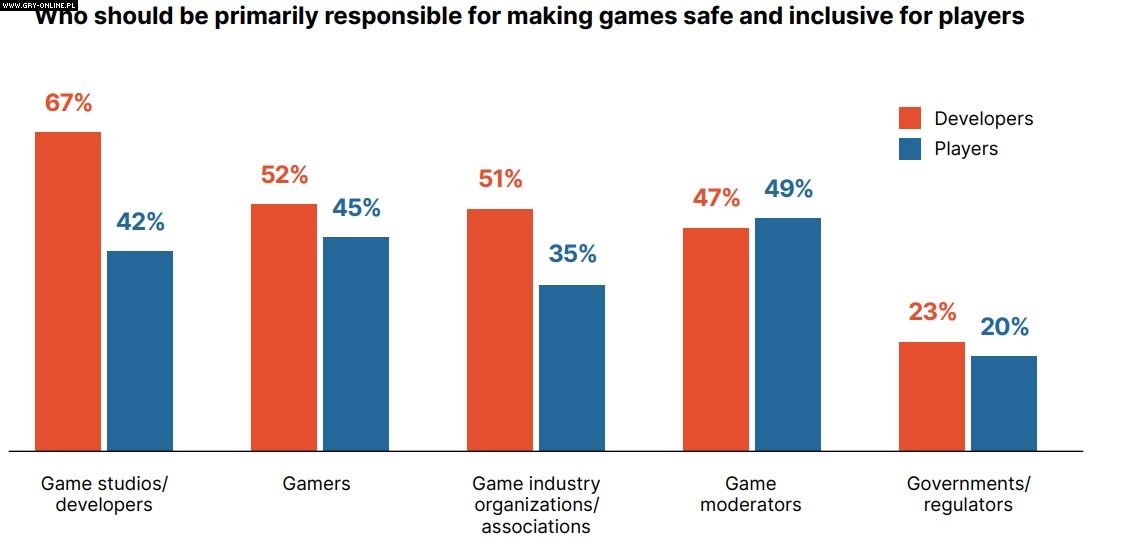
On whom does the fight against toxicity in video games fall down a notch?Source: Harris Poll / Unity.
Nevertheless, many people agree that a toxic community can effectively discourage people from starting or continuing to play a particular game. This applies to players and developers alike, with the latter pointing to the benefits of combating such behavior from their point of view: greater engagement, more frequent interaction between players and their recommending the title to friends and purchasing in-game items.
Developers responsible for fighting toxicity
As for the methods of combating the practice, quite a few players believe that the developers and moderators are primarily responsible for curbing toxic behavior, with which most developers agree.
- What's more, 81% of those surveyed felt that this should be a priority for the developers (77% in 2021). Here the opinion of game developers already diverges somewhat from that of players. True, 89% of them agree that much more can be done to combat "toxicity," but developers also do not consider it the most important issue.
- The issue comes down to the need to keep players interested in their title. Yes, "toxic" behavior is a common reason for survey respondents to abandon games, but by no means the most important one. More people are abandoning games as a result of lag, repetitive gameplay, in-game payments and lack of new content.
- Despite this gamers point to the lack of cheaters, bullying and so-called "griefing." as well as the most essential aspects of healthy online play (in addition to playing without lag-free and "fair" matchmaking). What matters most to developers is easy communication between platforms, lack of lag and fair matchmaking.
The report also mentions ideas for ways to combat "toxicity" - from punishing culprits by involving artificial intelligence to promoting "positive" behavior. Some players also wouldn't mind recording chat or the involvement of institutions outside the game market (if only state governments).
- New McDonald's Christmas AI ad is causing a stir. “It's the most terrible time of the year”
- GTA 6 devs have a growing problem. Concerns that Rockstar Games is failing to comply with labor laws are becoming more serious and „deeply troubling”
- It's official, Gainax, the studio behind Neon Genesis Evangelion, has ceased to exist after over 40 years in the anime industry
0

Author: Jacob Blazewicz
Graduated with a master's degree in Polish Studies from the University of Warsaw with a thesis dedicated to this very subject. Started his adventure with gamepressure.com in 2015, writing in the Newsroom and later also in the film and technology sections (also contributed to the Encyclopedia). Interested in video games (and not only video games) for years. He began with platform games and, to this day, remains a big fan of them (including Metroidvania). Also shows interest in card games (including paper), fighting games, soulslikes, and basically everything about games as such. Marvels at pixelated characters from games dating back to the time of the Game Boy (if not older).


Latest News
- Because of the final boss, I never gave up on entire genre, but the wonderful Rayman 2: The Great Escape hasn't aged a bit
- The free version of the cult classic shmup Tyrian has been updated after 4 years
- A new Nod campaign has been added to The Dawn of the Tiberium Age, a freeware Command & Conquer RTS
- Fans have removed the time limit from The Blood of Dawnwalker
- Empire II: Total War now with two extra historical campaigns