People rely too much on ChatGPT. Sam Altman admits that putting too much trust in the tool is a daily occurrence
OpenAI head Sam Altman has expressed worry about people's over-reliance on chatbots. Internet users see his statement as marketing rather than a real slant on the issue.

In the second half of July, Sam Altman participated in a conference organized by the Federal Reserve Bank. During his speech, he talked about the problem of using chatbots and how people are growing addicted to them. According to Altman, OpenAI is trying to understand where the idea of entrusting one's life decisions to AI came from.
OpenAI CEO draws attention to chatbot addiction
Issues of AI usage are already researched by scientists. Reports have emerged about cases of psychosis and users losing touch with reality. Some believed that they had created a sentient artificial intelligence or had become messiahs. At the same time, studies have shown that over-reliance on AI makes us dumber.
Sam Altman also commented on this matter, revealing that OpenAI is looking into the issue, as it heavily concerns young people:
People rely on ChatGPT too much. There's young people who just say like, "I can't make any decision in my life without telling ChatGPT everything that's going on. It knows me, it knows my friends. I'm gonna do whatever it says." That feels really bad to me. And is a really common thing with young people, and we're studying that. We're trying to understand what to do about it.
At first, it may sound like the CEO of OpenAI really worries about ChatGPT's influence on people's lives. People, however, took notice of his ending statement, sensing marketing aimed at investors regarding AI.
Internet users see marketing in Sam Altman's words
Near the end of his speech, Sam Altman says "Even if ChatGPT gives great advice, even if ChatGPT gives better advice than any human therapist." He wraps up by claiming he believes putting too much trust into AI is dangerous.
On the r/ChatGPT subreddit, users pointed out it sounds like he's marketing his own service. By seeming to express concern, Sam Altman may be trying to show he's a responsible businessman, making investors more willing to invest into OpenAI.
On the other hand, he's also saying that their tool is incredibly popular among young people, especially when combining his statements about young people being unable to function without ChatGPT and about the chatbot giving better advice than a human therapist.
Teenagers divided in trust towards AI
The impact of artificial intelligence on young people is still being studied. In mid-July, Common Sense Media published the results of the study Talk, Trust, and Trade-Offs: How and Why Teens Use AI Companions. It was conducted on 1,060 American teenagers from various age groups and focused on so-called "AI Companions", not standard chatbots.
According to the results, about 72% of teenagers have spoken to this type of chatbot at least once, and 52% are regular users, of which 13% use them every day. They do this for various reasons - 30% did it for entertainment, 28% are curious about new technologies, and 18% needed advice. The rarest response (6%) was loneliness.
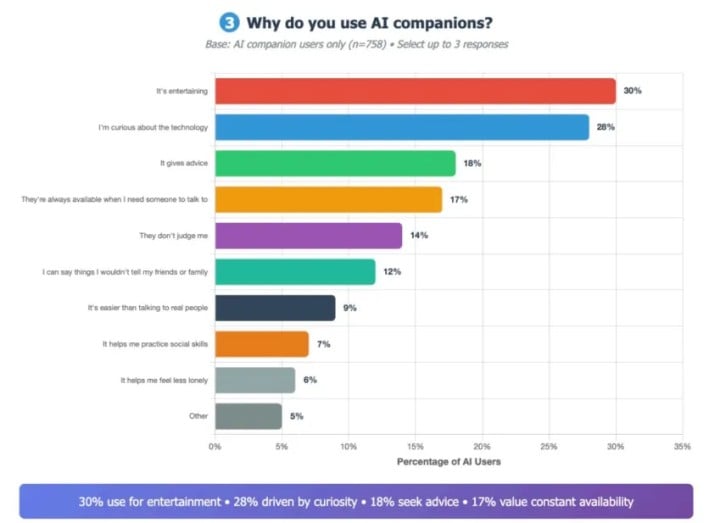
Results according to how trustworthy teenagers find these "AI Companions" are interesting as well. 50% of surveyed teenagers don't trust what the chatbots say, or trust them only a little bit. 27% trust them partially, while 23% trust them mostly or entirely. This means trust towards chatbots is equally split, with many young people aware that AI is prone to misinformation.
- Larian CEO Swen Vincke responds to generative AI backlash from fans
- AI „won't make The Witcher 5,” but CD Projekt Red doesn't despise it. Artificial intelligence isn't responsible for massive layoffs in the game industry
- „A lot has become lost in translation.” Swen Vincke suggests that the scandal surrounding Divinity is a big misunderstanding
0

Author: Zbigniew Woznicki
He began his adventure with journalism and writing on the Allegro website, where he published news related to games, technology, and social media. He soon appeared on Gamepressure and Filmomaniak, writing about news related to the film industry. Despite being a huge fan of various TV series, his heart belongs to games of all kinds. He isn't afraid of any genre, and the adventure with Tibia taught him that sky and music in games are completely unnecessary. Years ago, he shared his experiences, moderating the forum of mmorpg.org.pl. Loves to complain, but of course constructively and in moderation.


Latest News
- Because of the final boss, I never gave up on entire genre, but the wonderful Rayman 2: The Great Escape hasn't aged a bit
- The free version of the cult classic shmup Tyrian has been updated after 4 years
- A new Nod campaign has been added to The Dawn of the Tiberium Age, a freeware Command & Conquer RTS
- Fans have removed the time limit from The Blood of Dawnwalker
- Empire II: Total War now with two extra historical campaigns