Xbox Next more powerful than PlayStation 6, but price will be a „brutal wake-up call for console players”
AMD's „Magnus” is expected to give Xbox the flexibility to help move away from the traditional console design. A well-known leaker compared the performance of the next consoles to current graphics card models.

In the last few days, new reports have emerged about what we can expect from the next Xbox. It appears that information confirming Microsoft's shift away from the traditional console model - and toward a more PC-like approach - is becoming increasingly credible. According to experts, this shift could present a major opportunity for AMD, which - despite the solid performance of its latest graphics cards - continues to struggle to step out of Nvidia's shadow. The new reports contradict the rumors from June.
Xbox Next - closer to a PC than a console
The latest episode of the Direct Weekly Digital Foundry podcast focused on the recent leaks about Xbox Next, which turned out to be the hottest topic of the week. The discussion specifically centered on AMD's "Magnus" APU, which is shaping up to be a particularly intriguing piece of hardware. The CPU features a combination of three Zen 6 cores and eight Zen 6c cores. As for the GPU, it boasts a 192-bit memory interface, GDDR7 VRAM, and 68 compute units.
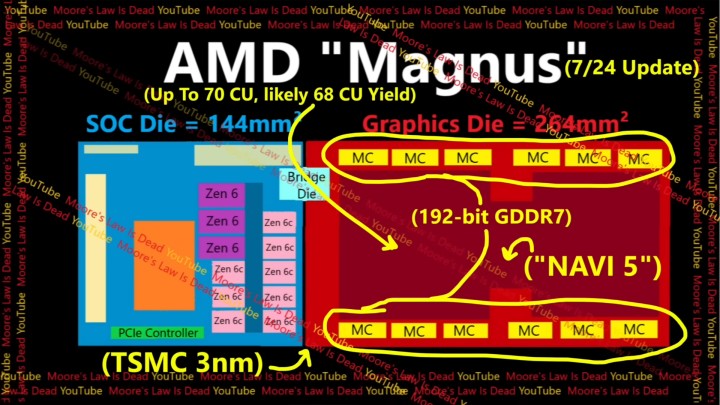
The specifications of the "Magnus" system make it clear that this won’t be a budget-friendly piece of tech - something that will almost certainly impact the final price of the console. That’s why the upcoming Xbox has been described as a potential "wake-up call" for players who’ve grown used to budget-friendly consoles. At the same time, the Digital Foundry team pointed out another possible reason behind Xbox's decision: the APU likely shares its graphics architecture with AMD’s upcoming line of GPUs.
This could offer more flexibility in developing multiple Xbox models, featuring either stronger or more modest GPUs - potentially marking the beginning of modular consoles. Digital Foundry also speculates that the entire next generation of Xbox consoles could be manufactured by third-party companies like Asus. In that scenario, Microsoft would shift their focus to software entirely. According to Digital Foundry, rasterization performance, ray tracing and machine learning is expected to surpass what current-generation hardware can deliver.
Xbox Next specification
System type: APU (CPU + GPU).
CPU:
- 3 Zen 6 cores;
- 8 Zen 6c cores.
GPU:
- 68 computing units (Compute Units - CU);
- 192-bit memory bandwidth;
- GDDR7 type graphic memory (VRAM).
PlayStation 6 and Xbox Next compared to current graphics cards
Well-known leaker KeplerL2 also shared insight on the next generation of consoles. When asked about the power of the upcoming consoles, they said the PlayStation 6 should perform like a Radeon RX 9070 XT, while the Xbox Next will be closer to a GeForce RTX 5080.
KeplerL2 also shared some AMD patents for RDNA5, showing that the new architecture stacks up well against Nvidia’s Blackwell GPUs - and in some areas, it might even offer a bit more.
Dense Geometry Format (AMD equivalent for Nanite Virtualized Geometry Unreal Engine and Nvidia's Mega Geometry):
- WO2025085121 - DENSE GEOMETRY FORMAT
- WO2025085120 - INTERSECTION TESTING ON DENSE GEOMETRY DATA USING TRIANGLE PREFILTERING
Streaming Wave Coalescer (optimizing the work of SIMD cores):
- US20250068429 - STREAMING WAVE COALESCER CIRCUIT
- US20250130811 - Spill-After Programming Model for the Streaming Wave Coalescer
Reduction of bottlenecks between CPU and GPU:
RT core improvements:
- US20250182377 - CONFIGURABLE RAY/EDGE TESTING FOR CONVEX POLYGON GROUPS
- US20250200890 - PRISM VOLUMES FOR DISPLACED SUBDIVIDED TRIANGLES
- US20250200865 - RAY TRACING OF DISPLACED MICRO MESHES USING A BOUNDING PRISM HIERARCHY
- WO2025144454 - SYSTEMS AND METHODS FOR DETECTING RAY INTERSECTIONS WITH DISPLACED MICRO-MESHES
The information suggests that AMD has prepared for a battle with Nvidia while working on the RDNA 5 architecture. At the same time, Microsoft's actions are an opportunity for them. According to Digital Foundry, the modular design of Xbox Next gives AMD the freedom to develop hardware without pressure from Nvidia, while Microsoft steps away from head-to-head competition with Sony and its upcoming PlayStation 6.
- PS Plus Extra and Premium for January 2026. 9 games in total, there are some hits
- GTA 7 or RDR 3 already in development? „I would be shocked” - Ex GTA 5 creator reveals what's most likely happening now at Rockstar studios
- Forza Horizon 6 with early paid access for wealthier players. Insider confirms release details
0

Author: Zbigniew Woznicki
He began his adventure with journalism and writing on the Allegro website, where he published news related to games, technology, and social media. He soon appeared on Gamepressure and Filmomaniak, writing about news related to the film industry. Despite being a huge fan of various TV series, his heart belongs to games of all kinds. He isn't afraid of any genre, and the adventure with Tibia taught him that sky and music in games are completely unnecessary. Years ago, he shared his experiences, moderating the forum of mmorpg.org.pl. Loves to complain, but of course constructively and in moderation.


Latest News
- A new version of Diablo, created by former Bethesda developers, finally enhances the 1997 classic with stunning HD graphics
- KaM Remake, the fan-made version of the classic strategy game, is practically finished
- A fan has enhanced and fixed the classic Ultimate Spider-Man for PC
- Because of the final boss, I never gave up on entire genre, but the wonderful Rayman 2: The Great Escape hasn't aged a bit
- The free version of the cult classic shmup Tyrian has been updated after 4 years