Towa and the Guardians of the Sacred Tree has many creative ideas, but ultimately suffers from a lack of focus
Towa and the Guardians of the Sacred Tree leans further into the story-driven elements than any roguelike or roguelite I’ve come across so far, and I would say it’s to the game’s overall detriment.

Something that can make or break a video game experience is the gameplay loop. Roguelikes and roguelites are built around “runs,” where the player takes on progressively more challenging enemies, gains random abilities, and tries to “win the run.” In Hades, you make choices about what powers to take, what allies to befriend, fight rooms full of enemies, take on challenging bosses, and when the run ultimately fails, you return to the starting point. That’s a full gameplay loop. You experience what the game has to offer in a cyclical experience. Non-roguelikes have these too, but rather than starting from the beginning, it results in some sort of progression.
A gameplay loop needs to have a good flow, balancing out the various sections of the loop so that they don’t overstay their welcome. For example, in Lost in Random: The Eternal Die, an action roguelite I recently reviewed, the end of every run returns you to a sanctuary. Here, there are helpful NPCs to talk to, some of whom will give you new abilities, weapon upgrades, or just share a brief dialogue. This section is a much-needed reprieve from the action, a brief opportunity to reconsider your strengths and weaknesses based on the last run, and a chance to save the game and return later. You can do all that, or you can jump right back into another run without interacting with anything or anyone. The sanctuary section of the gameplay loop only lasts as long as you want it to. The action is always readily available.

Towa and the Guardians of the Sacred Tree, Brownies, 2025
Games like Hades and The Eternal Die have an overarching story to follow. There’s lore to uncover, recurring characters, bosses, and other NPCs. They both do a great job of turning the run-based system of a roguelike into a compelling narrative. I wouldn’t say that’s something the average roguelike game is known for. Towa and the Guardians of the Sacred Tree leans further into the story-driven elements than any roguelike or roguelite I’ve come across so far, and I would say it’s to the game’s overall detriment.
Agents in the Fight Against Evil
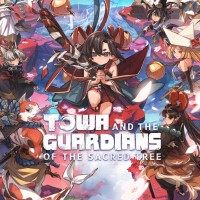
Towa and the Guardians of the Sacred Tree is an upcoming debut game developed by a studio called Brownies Inc. and published by Bandai Namco. My experience with the game so far is only a preview of what’s to come. I’ve only played the opening hours, levels, and bosses of the larger experience planned to be released on September 18th, 2025.
The story follows Towa, a half-god, half-mortal being, and her eight chosen guardians. They are all agents in the god Shinju’s fight against the malevolent forces of Magatsu, who wishes to conquer the world. In the opening mission, after defeating one of Magatsu’s generals, the guardians are all banished before they can cleanse the world of Magatsu’s influence. I’ll admit it was all a little bit confusing, but from that point onward, you must choose two of the guardians to take on roguelite-style missions to defeat Magatsu’s generals and deliver a powerful form of energy called mana.

Towa and the Guardians of the Sacred Tree, Brownies, 2025
The eight guardians are all unique and cleverly designed characters. Two that might stick out immediately are Nishiki, a humanoid Koi fish, and Bampuku, a plump humanoid Shiba inu. When tackling a run, you must choose two characters from the eight. One will be your primary melee attacker, or Tsurugi, while the other will be your spellcaster, or Kagura. You’ll mostly be moving about the battlefield in tandem, and you are only defeated when both characters’ health bars are depleted. Choosing the perfect dynamic duo and experiencing the unique, back-and-forth dialogue while on a run is an easy highlight of the game that makes it stand out from most other action roguelites.
Gameplay Loop Imbalance
The overarching narrative, the worldbuilding, and the character designs are excellent. But Towa and the Guardians of the Sacred Tree has trouble balancing its gameplay loop. A problem that can really drag down the whole experience.
In between runs, Towa can explore Shinju Village. There is an eclectic cast of residents to catch up with, some of whom have little to do with the gameplay or story, but they are there nonetheless. But there are also several NPCs who will help you manage items, unlock new abilities, and upgrade existing ones. Plus, a blacksmith minigame where you can design and craft your own sword in surprising detail. Your skill at the minigames also directly ties to the sword’s stats, which directly impacts the action and gameplay. If any future games steal a mechanic from Towa and the Guardians, it should be this.

Towa and the Guardians of the Sacred Tree, Brownies, 2025
However, Towa and the Guardians of the Sacred Tree spends too much time on cut scenes. I tried to come up with a more nuanced way of saying it, but there’s no way around it. There’s nothing inherently wrong with long cutscenes, but Towa’s placement of them within the gameplay loop throws the entire experience out of whack. After completing a run, whether success or failure, the player is often stuck on a railroad watching the characters engage in conversations or interactions that vary greatly in terms of their relevance to the gameplay.
Shinju Village could be a great sanctuary to take respite between action-heavy runs. But in some way, that needs to allow the player control, even if it’s to do nothing for a few minutes. Instead, most of the time, when I returned from a run, I had to wait through lengthy, unskippable cut scenes of the various characters interacting and conversing. I couldn’t help myself one time, and I decided to check the timestamps. After defeating the first boss, I returned to the village for 8 1 minutes of cut scenes and dialogue where I had no control over the character other than pressing X to move through the dialogue faster.

Towa and the Guardians of the Sacred Tree, Brownies, 2025
This would be forgivable if the cut scenes were easier to sit through. The dialogue often falls into classic tropes, and despite the large main cast of nine characters, they all feel the need to weigh in on topics of conversation. I was already getting tired of these lengthy scenes when an awkward topic came up, and I had to sit through eight dialogue bubbles of “...” as each character expressed their discomfort individually. I would argue that about half the lines of dialogue, and even some entire scenes, could be cut and the game would be better for it.
These lengthy scenes become a problem when they’re an unavoidable part of the gameplay loop. Other roguelites will tie the story more to the gameplay, or leave it as optional details to explore and discover at their own pace. But playing Towa and the Guardians of the Sacred Tree felt more like jumping between a TV show and a rougelite, rather than just playing a game.
A Few Too Many Good Ideas
Towa and the Guardians feels like a game that has some original ideas, but has so many of them it can’t quite focus on one and make it great. Which leads me to the combat. While it worked well enough, I wouldn’t say it stood out as the smoothest, most satisfying action I’ve played, even this year. The idea of having duos of warriors in play is clever and results in some fun banter between certain characters, but on the battlefield, it tends to feel awkward and clunky.

Towa and the Guardians of the Sacred Tree, Brownies, 2025
The rooms are not procedurally generated, as most roguelikes tend to be. So after several runs, they start to become repetitive. Enemies will vary slightly, and there are other kinds of encounters, like shops, restaurants, or hot springs. But the only real choice you have to make is what kind of reward you want for beating the next room. There’s no real strategy in choosing to avoid certain encounters or optionally take on a challenging fight for bigger rewards.
While the action is not the best, it does work. And there are some fairly in-depth customization options between handcrafting your own sword, mixing and matching abilities and upgrades, and pairing characters together. So, if you don’t mind some of the issues I’ve outlined, or maybe Towa’s story is enjoyable to you, this could be a great experience.
Out of the Loop
Overall, Towa and the Guardians of the Sacred Tree tries to do too much, and nearly everything is worse off for it. Going through an array of mini-games to craft a sword is a fun, original twist on a roguelike, and I do appreciate what it’s going for with the overall narrative and the odd NPC stories in the village. But the problem becomes that everything is fine, and nothing in particular stands out. Had the focus been more on the story, I might have forgiven some of the repetitive, clunky combat. Had the focus been more on fine-tuning the action and the flow of the battlefield, I could forgive some awkward story moments.

Towa and the Guardians of the Sacred Tree, Brownies, 2025
I want to reiterate that I have not played the full game yet; this was just a preview. There’s always the possibility that elements of the game will shift and change as you get deeper into the experience, or even change from what I experienced. But for me, the imbalance between the action and the story is what kicked me out of the gameplay loop.
Normally, when I pick up a roguelike, I want there to be few barriers between me and the action. They often present themselves as action-forward, gameplay-forward, fast-paced, and challenging. That’s not to say I’m opposed to a roguelike changing my thoughts on that and convincing me to enjoy lengthy cut-scenes with a dynamic cast of unique characters, but I wouldn’t say that Towa and the Guardians of the Sacred Tree has quite accomplished that yet.


0

Author: Matt Buckley
Matt has been writing for Gamepressure since 2020, and currently lives in San Diego, CA. Like any good gamer, he has a Steam wishlist of over three hundred games and a growing backlog that he swears he’ll get through someday. Aside from daily news stories, Matt also interviews developers and writes game reviews. Some of Matt’s recent favorites include Arco, Neva, Cocoon, Animal Well, Baldur’s Gate 3, and Tears of the Kingdom. Generally, Matt likes games that let you explore a world, tell a compelling story, and challenge you to think in different ways.


Latest News
- KaM Remake, the fan-made version of the classic strategy game, is practically finished
- A fan has enhanced and fixed the classic Ultimate Spider-Man for PC
- Because of the final boss, I never gave up on entire genre, but the wonderful Rayman 2: The Great Escape hasn't aged a bit
- The free version of the cult classic shmup Tyrian has been updated after 4 years
- A new Nod campaign has been added to The Dawn of the Tiberium Age, a freeware Command & Conquer RTS