MMORPG that could have threatened WoW's dominance. Warhammer 40,000: Dark Millennium Online died before it was born
Making an MMO game set in the Warhammer 40,000 universe is not an easy task. Vigil Games and THQ, which at one time worked on the ambitious Dark Millennium Online project, have found this out.

Contents:
Vigil Games studio had the potential to achieve tremendous success, not only to inscribe itself in golden letters in the history of video games (which it ultimately succeeded in doing) but also to join the noble group of developers that were real "gold mines" for their owners.
The team that had two installments of the Darksiders series under their belt was working on a title that could significantly shake up the MMO genre and threaten the popularity of the then-king, World of Warcraft.
MMO on par with Warhammer 40,000
I must admit, I don't particularly get along with the MMO genre. Despite everything, even I, after getting to know the information about Warhammer 40,000: Dark Millennium Online announced in 2007, decided that I would rather give this project a chance. Liking a futuristic universe where the war never ends is one thing. The second is the ideas that the devs had. Let's give the floor to Joe Madureira and David Adams, who in an interview for PC Gamer argued that:
The sheer scale of Warhammer 40,000 lends itself to experiences players have never seen in an MMO. The term “Battleground” takes on an entirely different meaning. Our battlegrounds will be more epic in scale, more intense, and more true to a game with the tagline, "In the grim darkness of the future, there is only war."
However, as the creators said in the same interview, all of this was not to "exclude more intimate battlefields, like other MMOs have."
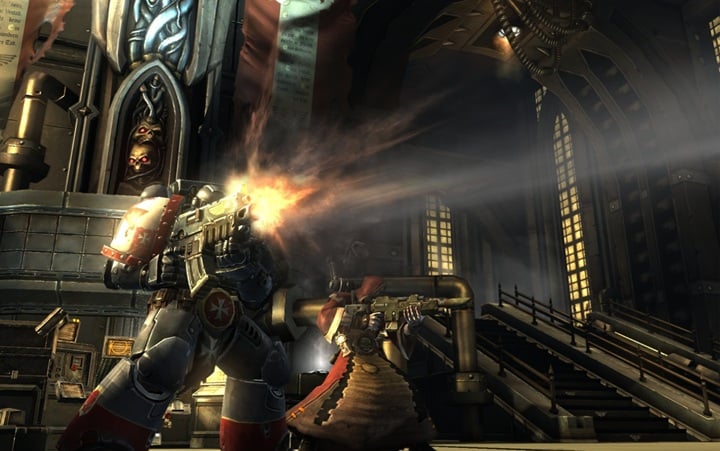
The main focus of the program in Warhammer 40,000: Dark Millennium Online was supposed to be fighting against opponents. The fights were supposed to be not only fast-paced, but also "deep," with mechanics of taking cover and the possibility of flanking enemies. Apart from the weapons at our disposal, we would also use various vehicles and machines on the battlefield. Some of them would be really powerful, designed to be operated by several pilots (large battlefields oblige).
Not only the fight
Even though the game would be set long after the Horus Heresy, when war would still be a part of everyday life, it would also offer activities other than fighting. Here again, I have no choice but to give the floor to David Adams again, who proudly announced in the same interview:
We want to build a Warhammer 40,000 world that extends beyond the battlefield. This will involve cities (of all scales, types and sizes), exotic alien temples, Chaos shrines, deserted battlefields, mysterious ruins, ancient structures, drifting hulks in space, etc... Warhammer 40,000 is a universe filled with mystery - where the unknown lurks around every corner, ready to kill you.
The locations wouldn't be empty mock-ups, but would pulsate with life thanks to a wide range of independent characters. During the game, we were supposed to meet citizens of the Empire, Chaos cultists, xenomorphs, demons, and ancient machines. Among them, we would find both opponents and potential allies.
When it comes to the missions waiting to be completed in the game, there were supposed to be not only combat-related tasks, but also quests that would allow you to explore the entire universe better. Depending on the quest, we could work on it alone or in groups, and there would also be opportunities to compete with other players.
Character in the center of chaos
Even though the creators presented us with a vision of a world inhabited by diverse races, they were only able to confirm one playable race - humans. Due to the desire to maintain consistency with the entire universe, we wouldn't experience non-combat classes here. Nevertheless, in order to avoid an "attack of clones," the creators intended to provide us with a wide range of equipment and cosmetic additions (weapons, armor, books, scrolls, and chains) that would allow us to stand out from other players.
As could be read in the announcement on IGN:
...it's more of an RPG. You live the life of this guy (...) for months, maybe even years. What are these guests doing outside the battlefield? What do their interactions with other races and in different worlds look like? It really gives you a unique perspective (...).
Unexpected change of plans
So as you can see, the devs had really ambitious plans. Unfortunately, reality brutally verified it, and their dreams finally crashed against the limitations of possibility. The production costs of Dark Millennium Online were increasing month by month, while the financial situation of THQ overseeing it was getting worse and worse. As if that wasn't enough, other seemingly destined-for-success MMOs, led by Star Wars: The Old Republic, had trouble meeting their publishers' expectations. As a result, in March 2012, a decision was made to completely change the nature of the title in question.
From now on, Warhammer 40,000: Dark Millennium would no longer be an MMO game, but a production focused on a single player, enriched with an extensive multiplayer mode. The whole thing changed so much that it was... looking like the Borderlands series.

Fall
Unfortunately, THQ was already in trouble at that time, and their bankruptcy filing in December 2012 buried the whole project. In the end, Warhammer 40,000: Dark Millennium Online died before it really had a chance to be born. The team behind it, Vigil Games, was dissolved, and its members went on to work for other companies.
- Open-world MMORPG once expected to impress at every turn. EverQuest Next would offer environmental destruction and „living” AI
- Most important question of the series without answer. Only Dead Space 4 could reveal the truth about the Necromorphs
- World of Warcraft is changing. Blizzard is modifying a system that players have used for 20 years

- THQ
- Warhammer 40,000 (franchise)
- MMORPG
- Vigil Games
- cancelled games
- Necro Gaming
0

Author: Christian Pieniazek
Started working with Gamepressure.com in August 2016. Although the Game Encyclopedia has been his pride and joy from the beginning, he also writes for the Newsroom and the Editorial section. Gained professional experience through a now-defunct service, in which he worked for almost three years. Graduated in Cultural Studies at the AGH University of Krakow. Runs his own business, jogs, cycles, loves mountain hiking, is a fan of nu metal, is interested in space, and of course, enjoys playing games. Feels best in action games with an open world and RPGs, although won't turn down good racing or shooting games.

Latest News
- KaM Remake, the fan-made version of the classic strategy game, is practically finished
- A fan has enhanced and fixed the classic Ultimate Spider-Man for PC
- Because of the final boss, I never gave up on entire genre, but the wonderful Rayman 2: The Great Escape hasn't aged a bit
- The free version of the cult classic shmup Tyrian has been updated after 4 years
- A new Nod campaign has been added to The Dawn of the Tiberium Age, a freeware Command & Conquer RTS