This game left nearly everything what's „Fallout” behind. Meet the forgotten Fallout: Brotherhood of Steel
Fallout: Brotherhood of Steel is a now forgotten title that introduced this post-apocalyptic universe to console players long before Fallout 3. It was also Interplay's swan song.

In 2004, Interplay was way past its prime. The developer and publisher, who made a golden mark in the history of video games with titles such as Baldur’s Gate, Icewind Dale, and Planescape: Torment, was soon to fade into the nothingness, from then on basing its activity solely on managing those series that remained in its hands.
Fallout was also one of the franchises created by Interplay. Although at that time the post-apocalyptic series was mainly popular on personal computers, it also had the chance to be seen by console players, although not in its full glory. Long before Fallout 3 hit PlayStation 2 and Xbox, there was a game called Fallout: Brotherhood of Steel, an action RPG trying to do for the Fallout franchise what the Dark Alliance subseries managed to do for the Baldur’s Gate series.
The attempt was made, but overall it didn't really work out. Because of this, few people today remember that such a title was even made. However, I remember it well because it was my first encounter with that universe and, to be honest, with truly post-apocalyptic vibes. And you know what? I remember my first visit to the devastated America quite fondly... although with the perspective of time, I see what missteps the devs of this creation made. But let's start from the beginning.
Fast-paced action in the wastelands
Even though I knew what Fallout was in 2004 (thanks to my "addiction" to reading Game Encyclopedias), I didn't actually have any direct experience with the series until I got my hands on its console version. For the next four years, whenever I thought about this brand, the first thing that came to mind was screenshots from the first installment of the series, and then memories of playing on a tube TV with a controller in hand. The gameplay was quite different from the original, though.
Fallout: Brotherhood of Steel emphasized fast and spectacular action. The story, although present, was pushed into the background. The most important thing was exploring locations, fighting enemies, completing quests, and leveling up your character to take on stronger foes.
The title gave us three playable characters to start with, and we could unlock three more as we progressed. My favorite was Cyrus, the most versatile warrior who excelled in both close combat and taking out enemies from a distance. Besides, there was Nadia (weaker, but more agile and better at handling firearms) and the ghoul Cain (capable of really hitting hard) at our disposal. Interestingly, many players still mention the presence of the last one as one of the biggest advantages of Fallout: Brotherhood of Steel.
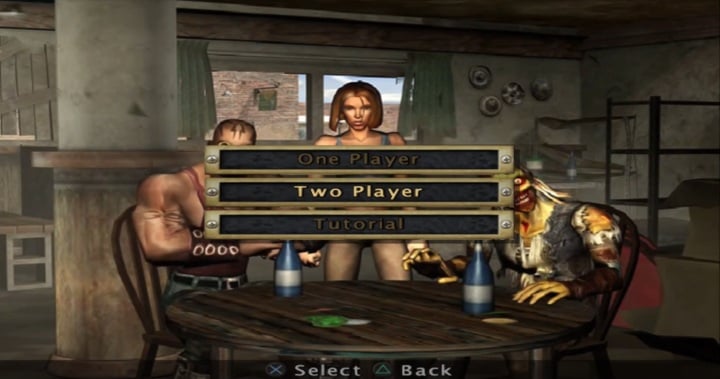
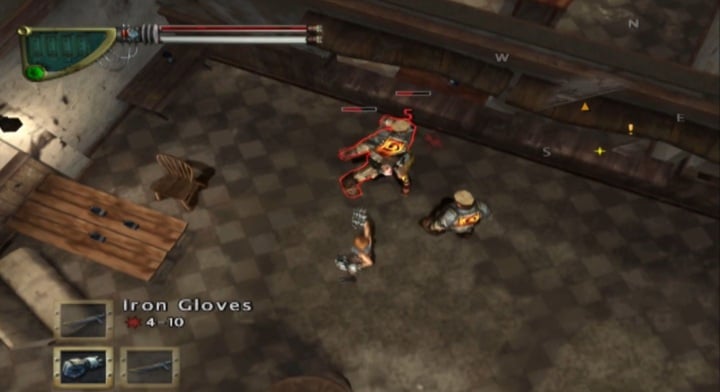
We eliminated enemies using a wide range of weapons and gadgets. The arsenal included, among other things, energy pistols, grenades, and combat gloves. In contrast to the slow original, which focused on tactics and deliberate actions, the key to success here was constantly moving and being agile to avoid enemy attacks. The character development system, on the other hand, is based on perks awarded after gaining the next level of experience. These improvements affected our characters in various ways, for example, by increasing their speed on the battlefield.
Another key difference compared to the original Fallouts was the linear structure of Fallout: Brotherhood of Steel. The game "blocked" us in a certain location until we made enough progress in the story to gain access to the next one. You could have extended your stay in a place by chatting with the NPCs and taking on side quests from them (you could also trade with some of them).
It should also be mentioned about the implemented co-op mode. In Fallout: Brotherhood of Steel, you could play together with a friend on the same screen. As is often the case, even if we don't particularly like a game, co-op improves the fun. That's how it was here, too, because wandering through the wasteland with a buddy was much more fun than exploring it alone.
Other wastelands
As the title suggests, Fallout: Brotherhood of Steel allowed us to play as a member of the Brotherhood of Steel, trying to bring order to the post-apocalyptic wastelands. Our main goal was to find a group of paladins who disappeared near the town of Carbon.
Even though the description above suggests that Interplay's game was a pretty standard version of Fallout, but more action-oriented, in reality, the game differed from its predecessors in more ways than just gameplay.
Wanting to make this position more accessible for new players, the creators decided to abandon the retro-futuristic style and went for atmospheres more reminiscent of Mad Max (or, from today's perspective, for example, the Rage series), rather than the classic Fallouts.
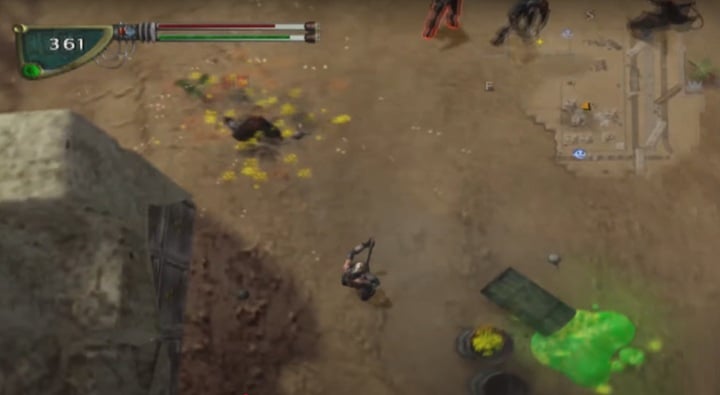
This impression was intensified by the soundtrack, where metal tracks from bands like Killswitch Engage and Slipknot replaced mid-20th-century songs. Although I was totally into it in 2004, looking back now, it seems totally incomprehensible to me. Who was bothered by the classic Fallout soundtrack? Moreover, who was bothered by Nuka-Cola that they decided to replace it with the identity-less (but licensed) Bawls?!
It's worth mentioning that the devs didn't take themselves too seriously, so the whole thing is spiced up with a good dose of humor. This was all accompanied by many swear words; although, as I presume, they were meant to emphasize the brutal nature of the game world, their intensity seemed rather grotesque (but also charming in its own way).
Wastelands with issues
Fallout: Brotherhood of Steel also suffered from problems of a different nature. The devs didn't manage to deal with the problem of monotony creeping into the gameplay, which made the game painfully repetitive over time. Moreover, the camera work was not great and its "quirkiness" could have given us a headache.
All of this has made Fallout: BoS be called by players as Fallout: PoS (Piece of Shit) today. However, there are voices saying that the game had its charm. It might have lagged behind its predecessors in terms of execution quality, but it still managed to provide several hours of decent gameplay (if only we were able to turn a blind eye to its flaws).
What's interesting, despite the rather cool reception of Fallout: Brotherhood of Steel, Interplay was thinking about making a sequel. The game was supposed to follow in the footsteps of the first Fallout games, offering reputation mechanics based on our decisions and a stealth system. Unfortunately, the work on this project had to be put on hold at a quite advanced stage.
How to play Fallout: Brotherhood of Steel today?
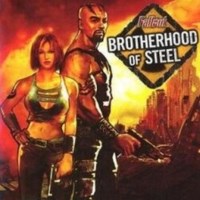
If you are not afraid of changes compared to the original Fallout titles and would like to play Brotherhood of Steel, then you have no choice but to look for used copies of this game.


1

Author: Christian Pieniazek
Started working with Gamepressure.com in August 2016. Although the Game Encyclopedia has been his pride and joy from the beginning, he also writes for the Newsroom and the Editorial section. Gained professional experience through a now-defunct service, in which he worked for almost three years. Graduated in Cultural Studies at the AGH University of Krakow. Runs his own business, jogs, cycles, loves mountain hiking, is a fan of nu metal, is interested in space, and of course, enjoys playing games. Feels best in action games with an open world and RPGs, although won't turn down good racing or shooting games.

Latest News
- A fan has enhanced and fixed the classic Ultimate Spider-Man for PC
- Because of the final boss, I never gave up on entire genre, but the wonderful Rayman 2: The Great Escape hasn't aged a bit
- The free version of the cult classic shmup Tyrian has been updated after 4 years
- A new Nod campaign has been added to The Dawn of the Tiberium Age, a freeware Command & Conquer RTS
- Fans have removed the time limit from The Blood of Dawnwalker