Assassin's Creed and Splinter Cell wouldn't have been made without this game. Ubisoft's The Drift was to turn into James Bond
The video game industry has it that other projects are built on the ruins of some. Such was the fate of The Drift from Ubisoft, which can be considered the prototype of the Splinter Cell and Assassin's Creed series.

Nowadays, Ubisoft is associated with schematic games where finding anything innovative is futile. Some people might say that the company's recent projects look best in Excel, even before it gets the green light and actual development starts.
But it wasn't always like that. The French giant used to go above and beyond to surprise players with new gameplay ideas. One of such ambitious projects could have been The Drift. Although it was eventually canceled, it all worked out for the best because it led to the birth of at least two iconic franchises.
Narrative chaos
Once upon a time, a development studio worked under the wings of Ubisoft, whose headquarters were located in New York. In 1999, this team was tasked with creating a TPP shooter. With time, the team was disbanded, and the project was sent to Ubisoft's branch in Montreal for further development.
The Drift, as this enigmatic game was called, never left the conceptual phase. Nonetheless, the game has already taken on quite distinct shapes. What's interesting, the devs and publisher had at least three ideas for its plot.
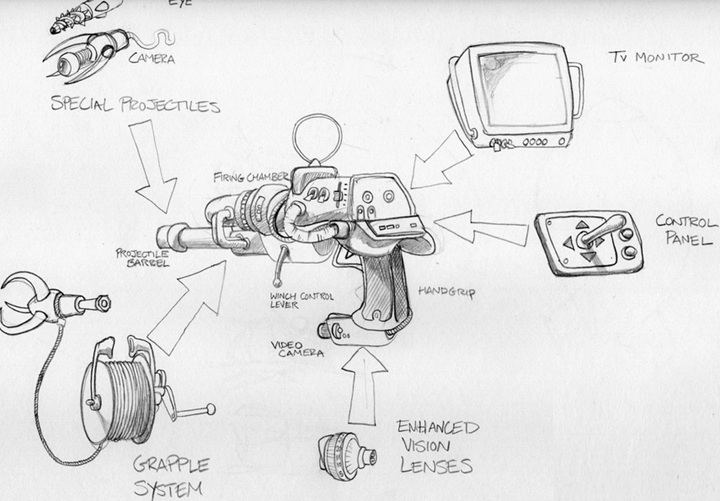
The first one was set in a retro-futuristic and post-apocalyptic version of the 1970s. After the Earth was destroyed, the remaining humans were supposed to live on its rocky fragments and build new cities there. The main character was planned to be a certain Buster, who was supposed to have an interesting modular weapon.
The second idea involved preparing a game inspired by James Bond, while the third one was about adapting the whole thing to the realities of the novel "The Sum of All Fears" by Tom Clancy. In practice, none of them actually happened.
Splinter Cell and Assassin's Creed series progenitor
The mysterious "gun" I mentioned earlier was supposed to have a bunch of other functions besides shooting. The creators wanted it to also serve us as a launcher for a rope with a hook, and they also planned to equip it with viewfinders providing several viewing modes.
Another cool feature that was planned for The Drift was an artificial intelligence system that would ensure realistic behavior for both individual characters and entire crowds. Thanks to it, NPCs were supposed to dynamically react to our actions, so running past a group of people with a drawn weapon would certainly not go unnoticed by them.
Over time, one of the Ubisoft Montreal designers, Nathan Wolff, decided to enrich The Drift's mechanics with elements straight from spy action cinema. Thus, the title gained a stealth system.
Something ends, Something begins
In the end, the decision was made to cancel The Drift and start a new project, using some of the ideas developed for this one. We're talking about Tom Clancy's Splinter Cell, where Ubisoft wanted to see a "killer of Metal Gear Solid 2." After The Drift, elements such as espionage themes and a stealth system remained in Sam Fisher's first adventure, which gave it a cult status.
As for crowd mechanics - this, of course, came in handy later in the Assassin's Creed series. What's interesting, after years, this mechanic could have also ended up in Tom Clancy’s Splinter Cell: Conviction, but in the end, the original concept of this production changed completely. But that's a topic for another story...
It should also be noted that after The Drift, nothing remained except for the information provided by IGN and the concept arts that served as illustrations for this text.


0

Author: Christian Pieniazek
Started working with Gamepressure.com in August 2016. Although the Game Encyclopedia has been his pride and joy from the beginning, he also writes for the Newsroom and the Editorial section. Gained professional experience through a now-defunct service, in which he worked for almost three years. Graduated in Cultural Studies at the AGH University of Krakow. Runs his own business, jogs, cycles, loves mountain hiking, is a fan of nu metal, is interested in space, and of course, enjoys playing games. Feels best in action games with an open world and RPGs, although won't turn down good racing or shooting games.

Latest News
- KaM Remake, the fan-made version of the classic strategy game, is practically finished
- A fan has enhanced and fixed the classic Ultimate Spider-Man for PC
- Because of the final boss, I never gave up on entire genre, but the wonderful Rayman 2: The Great Escape hasn't aged a bit
- The free version of the cult classic shmup Tyrian has been updated after 4 years
- A new Nod campaign has been added to The Dawn of the Tiberium Age, a freeware Command & Conquer RTS