“Broken Is Fun.” The Co-Op Shooter Embracing Chaos, Meat, and Zero Balance. Let’s talk about Swapmeat with Jamie Stormbreaker, One More Game co-founder
The developers of one of the most unique roguelike action games, Swapmeat, explain how they came up with one of the most uniquely disgusting mechanics.

A few weeks ago, I had the chance to sit down and play an early demo for the third-person shooter roguelike SWAPMEAT, where up to four players can participate in co-op chaotic roguelike action, where you swap out body parts with defeated enemies. It’s just as tumultuous and gross as it sounds, but also tons of fun. Since recording this interview, Swapmeat has launched in Early Access on Steam, so it is available to play now. A free demo is still available if you want to test it out before buying.
When I jumped into the demo, there was no time to wait. I got straight into the action with a gun in one hand and a spatula in the other. Before I even knew what I was doing or what my objective was, I was shooting spiders and then swapping out my somewhat normal two legs for a set of eight. The core concept sank in immediately.
In the brief time I had with the demo, I tried to test out every body part I could find, and there was no shortage. I found an insect head that let me spit acid, a set of wheels for legs that let me dash at high speed, and so much more. Swapmeat is like Risk of Rain 2, but disgusting in the best way.

Source: SWAPMEAT, developer: One More Game
Following my time with the demo, I had the opportunity to speak with Jamie Stormbreaker, the co-founder of One More Game, the studio behind Swapmeat. We get into why the studio has that name and how it defines the team’s philosophy when creating games. I was very curious about how the team came up with this unusual game mechanic, and thankfully, I got some answers.
Please note this interview has been lightly edited for context, clarity, and relevance.
My interview with Jamie Stormbreaker, the co-founder of One More Game, developers of Swap Meat
Matt Buckley, Gamepressure: Hello Jamie. Great to meet you, thanks for taking the time to sit down and talk.
Jamie Stormbreaker, One More Game: Great to meet you, too.
MB: How has your convention experience been so far?
JS: It has been great not just for showing the game, but as, like, a focus group test. So like watching people play. Every night, we update the game based on what we watched on the show floor. I’m usually up until 1 a.m. updating the game.
MB: That’s great. Why don’t we start there? What’s some of the stuff that you’ve noticed people are doing that changed something about the game?
JS: We shared the game at Gamescom. Some of the things we observed on the game floor were that the game was too difficult, but it was difficult in an odd way, or, not an odd way, but in a combinatorial way. So, like, enemies on their own weren't that challenging. And we knew that. We tuned the game in that way. But when developers aren't playing, it's very different from when brand-new players are.
We've been publicly testing this game for a year and a half. So every two or three months or so, we update the game, we open it up, and we have another public play test.
So, for gamescom, we adjusted a number of systems from the last public playtest, and then we finally started seeing them for the first time on the show floor. And so we took a bunch of notes, and then addressed a number of issues with movement impairing effects, this snowball of enemies adding in, and players kind of getting stuck in the mud, it felt like. And then when we came here on Friday, it was all, “no problems with that.”
MB: Okay.
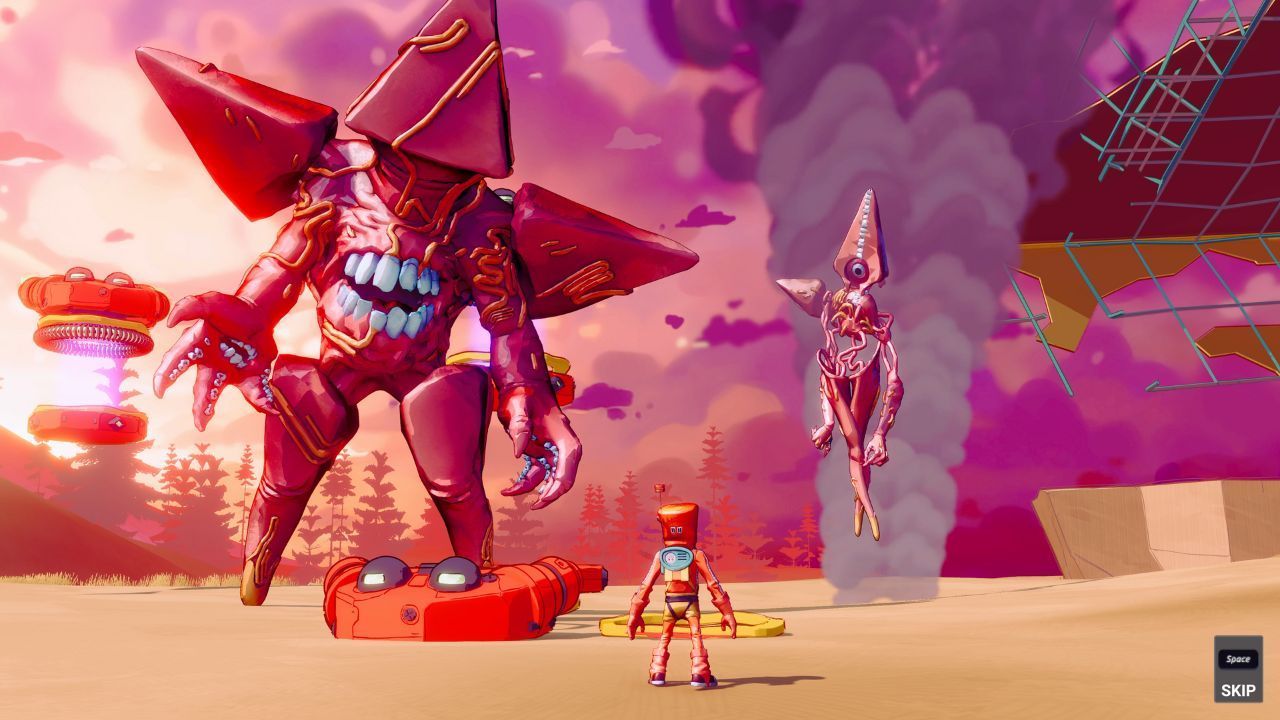
JS: The new problems were so much fun. My favorite ones. So, the whole point of the show floor – there’s a tutorial in the game, but we’re not giving it to you. We want to see how intuitive the game is.
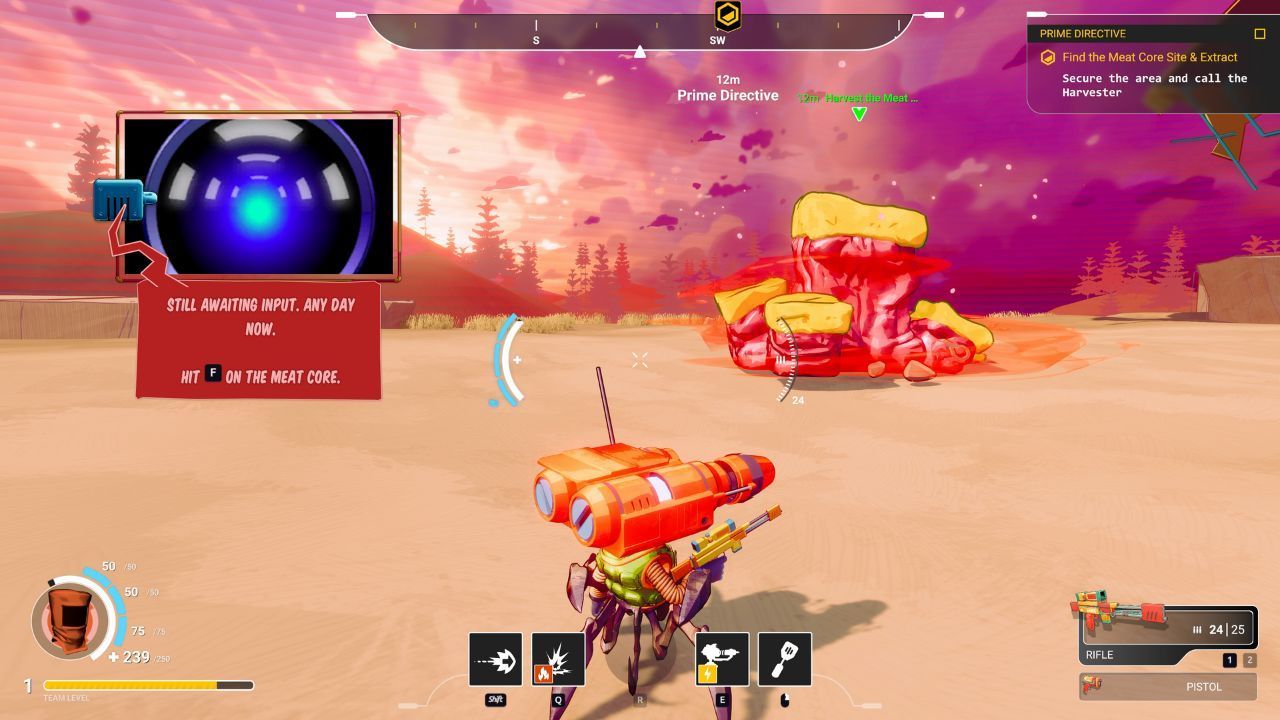
And so people would spawn in, orient themselves, look right, and then they'd see, “oh, a green marker on the screen. It says health station,” and they’d go right to it. Like an eighth of the players, let’s say. I was like, “Man, I need to fix that.” Then I thought. “No, I'm stupid.” That marker is really good at drawing people to the wrong thing. Just put it on the right thing.
So, we move that marker instead to be on the prime directives, which is the thing we're supposed to do next. So whatever one you're supposed to do next, you can go to. We come to the show floor the next day, update the machines. I watch, you know, I observe for about an hour. It's fixed. Yeah. So these little things. And it's been like a year of this problem.
MB: It's funny how the little things can make such a big difference.
JS: Yeah, yeah. You're equally good at your job and also equally terrible at your job. Game design and development are just about psychology. It's great.
Source: SWAPMEAT, developer: One More Game
MB: So, there's already been a few public playtests?
JS: Yeah, the last one is the seventh one. And, you know, we've been open. Every test we do has no NDA. It's in the public. You can stream it, you can make videos about it, you can do whatever you like. Earlier play tests were less, you know, complete.
The thing about One More Game is that we respect your time as a player and as a potential player. I can't guarantee that the game is fun, but I can guarantee it's not broken. So anytime you test a game that One More Game makes, it should work. And if it doesn't, we will fix it right away. During the test, we are updating the game every day.
We have a lot of automation, automated crash reporting. We know when something goes wrong, and we fix it right away, and then, depending on how severe it is, we'll push out an update.
But eventually the game will be fun. And so early versions of the game, it's still really critical that we have player feedback. Especially if you're a game like Swapmeat, which has a mechanic that doesn't exist in any other game.
MB: Right, yeah. It's very unique.
JS: Yeah, it took us a lot of time to figure out things like how often you should swap the body parts out. What should be on the body parts? Do you have legs, a torso, and a head? What kind of abilities can go on them? Should there be any rules about what abilities can go on them? So we came up with things like, “the legs are always some sort of movement.” It's not always a dash. You might have gotten the Squat Daddy legs, where you can like jump really high and slam down, like the wrestler legs, so it’s like this vertical jump.
MB: Wow. Squat Daddy. [laughter]
JS: Yeah. We think we’re funny. We think we're very funny.
MB: Video games are such a great place for humor. But I didn’t mean to interrupt.
JS: Oh, it's okay. Yeah, and then the torso, a lot of the time, it's not aimed. It's what I call self-cast, or what World of Warcraft would call self-casts. Non-targeting. With the head, it will usually require more targeting.
We wanted to make sure the controls were familiar and consistent, like in a hero shooter. But we also didn’t want the mechanic to get in the way of that. So, some accordances that other games provide players while also delivering this crazy experience that's not just visually odd, but like what happens when a player gets these legs and this torso? We don’t have set bonuses. It's not an RPG, but there are combinations where the abilities will contextually work better together. A lot of those are the movement abilities that, if you combine them with a torso… so, there is flight in the game, you might not have found it.
MB: I think I found at one point found a torso that had wings on it. And I didn't figure out if I could fly or not.
JS: All right. See, you can't. So this is one of the coolest things about developing with players is they find bugs, and then you're like, “Okay, we'll fix that, or we'll make a feature.” And so, some of the earliest, easiest body parts to get are spider legs and a wasp torso. And so, for over a year, we were trying to figure out flight, but I didn't want to give someone a button that like turns them into a jet. What we wanted to do was figure out how to get to the Super Mario World Cape. How do we get the raccoon tail? What do we do to get that iconic ability? So there has to be some level of skill in mastering the flight.
So, the bug that we found first that led to this was spider legs. You could jump, and if you dashed when you were in the air, you went really far. And so, if you used them today, they will still go farther in the air. And we found that, patched it, made it a feature. Now it can be tuned. The next one was the Wasp torso, which has the wings. And if you press it and you're in the air, it also goes further. But both of those abilities, sorry, both of those body parts also give you one extra jump each. So you'll get four jumps. And then they have lower cool-downs. And so the last piece to make flight happen was some torsos, including the wasp, can reset your jump count. So, if you're jumping, dashing, using all your jumps, then use the wasp torso; it will reset them, and you can do it all over again.

Source: SWAPMEAT, developer: One More Game
MB: Ok. That's really fun.
JS: Right. And then what we do, so making big PvE co-op games is excellent because broken is just fun. It's overpowered. No one complains or gets mad about it. I don't need to balance it. And I don't want to balance it. I don't want to be the fun police.
MB: That's such a great thing because, and maybe it's just me, like in my trajectory playing games, but I'm at a point where PvP is not super interesting to me. I don't always have the time to dedicate to mastery over a game. So, I'd be curious to know whether there was a philosophy behind your decision to make it PvE? Or were there any other ways it could have gone or anything like that?
JS: No, we made that choice very, very early. So, this is our second title. Two years ago, we started development for prototyping. We had a number of prototypes throughout the summer of 2023. The product framing for the prototypes was that we wanted frictionless co-op. One to four players. We wanted the game to have no difference between a single or multiplayer, meaning, like, you don't need to choose. I'm playing single or multiplayer. We knew we wanted to build a shooter. Third or first person, that didn't matter. And then we did like the roguelike genre, and we were like, “Look, we think we could do some really good work.”
But let's go to the co-op thing. The frictionless co-op. I've worked on Guild Wars, Guild Wars 2, and League of Legends. We have a number of folks who have worked on these games. My business partner was the first hires at Blizzard. was Mike Morheim's roommate, named Patrick Wyatt. He was the programmer-producer, one of the designers on StarCraft, Warcraft, and Diablo. He founded ArenaNet, which made Guild Wars. So, we have a lot of pedigree in competitive online games.
But we chose this because I think, especially after COVID, players started wanting to play with their friends more, they got used to it, and they understood what playing not single player games was like. And so we made a pivot from making competitive games. Instead, we said, “How do we just enable this frictionless cooperative play?” And then it unlocks a bunch of stuff for you. So, you know, we have no economy to worry about. I don't need to balance that. We don't have PvP. The abilities don't need to be balanced.
MB: You can make them broken.
JS: I can make them broken. It is not a design goal that every body part has an ability as good as the others. Contextually, they might be more powerful. You know, if you're in an area that has a lot of water and you get the squid legs, you go 500% faster in the water. You might not want them if you’re not in the water.
But the product framing was like feelings. So, One More Game, the name of the company, comes from the feeling: It's like Friday night. 1 o'clock. You're playing with your friends. “Just one more game. Just one more. Just got to do one more.” And so we wanted to make sure that our cooperative supported the friend group that's got, you know, the person who's going to carry everyone, a person who's not particularly good at shooters, but it doesn't matter. We want to make sure that all the systems work for everybody. If you're playing as a group, it should always be a good opportunity to go play with friends.
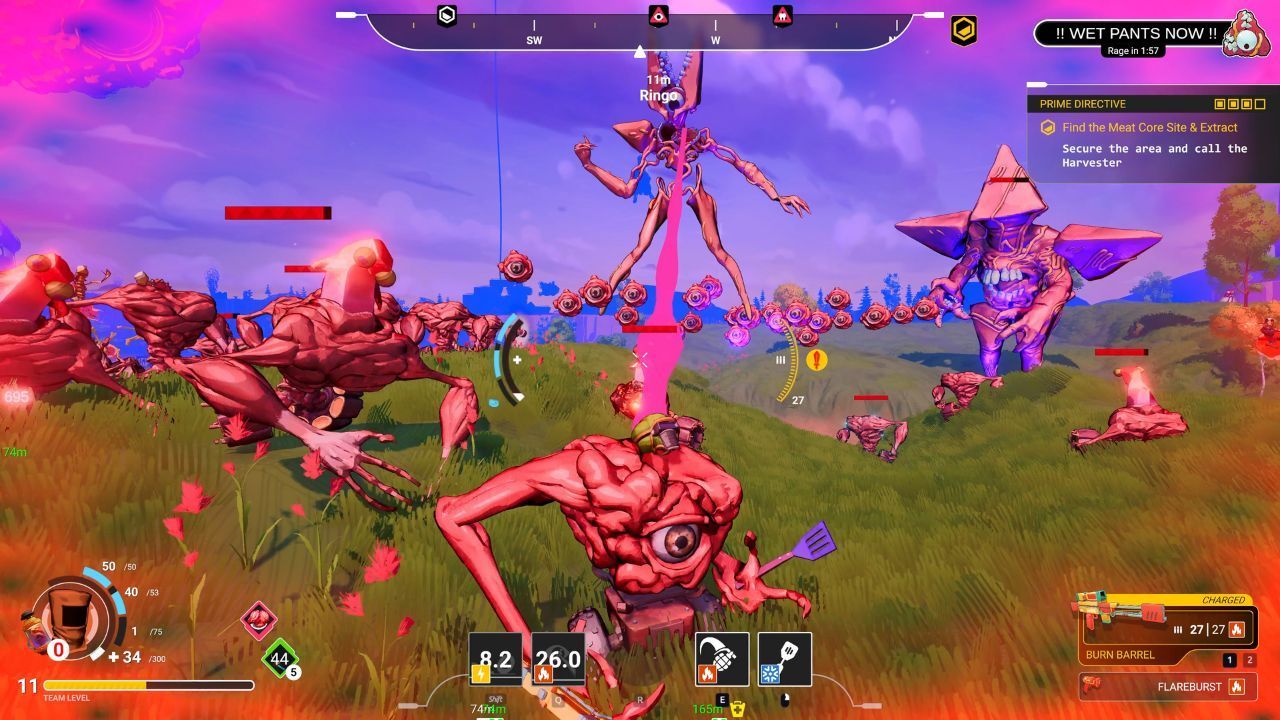
I'm a massive fan of MMOs, and I only ever wanted to make games because of EverQuest. The problem is like, you know, I'm level 60, you're level 12, you can't play with me. So we wanted no restrictions on the ability to play with each other. You know, you're in Discord, and I see that you're playing. I'm going to drop into your game. We have dynamic difficulty scaling, so as people join the game, the game will get more difficult. If they leave, it'll get easier. The bosses are all designed with raid-like mechanics in mind, like World of Warcraft or Final Fantasy XIV. Those are all inspirations. But, bringing those into what it's like to play with four players or even as one. So they all have to be designed to work on both scales.
And then, you know, there's a campaign in the game with a narrative.
Source: SWAPMEAT, developer: One More Game
MB: Okay, that was going to be my next question. Narrative isn’t always easy to deliver in a roguelike game, but some have figured it out, such as Hades.
JS: Yeah, so Hades is a big inspiration. I wanted to deliver a little narrative. This game is ridiculous. It's very ridiculous. We would really be missing out if we didn't tell you a really ridiculous story. So, with that drop-in, drop-out, we also have non-linear narrative progression, which means that if you're further on in the story, and I join your game, I can still play with you. And anything we accomplish together still attaches to my save file. So if you ever played Diablo 2, it's like that. You get a quest journal. You don't need to do it in order. You know, if you join, “the minions of Hell have gotten stronger.” And so that is the inspiration that we took. It was actually a hard problem to solve.
MB: That's great. I'm a big roguelike fan. It’s impressive when they are able to somehow get the story through, even though you're going on all these runs and constantly starting over from the beginning. So yeah, that's really cool. So, another question I have to ask is: what inspired the whole swapping-out-body-parts mechanic? It’s such a unique mechanic.
JS: So when I talk about project framing, it's really dry. It's going to be like three people interested in this. We start from there, and then we're like, “What is our unique hook?” What do we tell someone? How do you tell someone at a bar, or like at your gym, or whatever, in like 60 seconds or less, how do you tell them what this crazy game is that you just played? And that is critical to what a hook will be. And so our director, Jason Stone, had this prototype of a Contra side-scroller, and it had this mechanic where you could steal enemy parts, and they would give you different things. And we were like, “That would do it.” But what does it even look like in 3D space, though? Like, how do we do it? So we started prototyping with that. We had a game already, a prototype, and we started layering these mechanics in. And that's the beginning of it, it was just like, “What does it look like?” Then we started to answer questions. We've been really careful to make sure that it's not a gimmick and it's essential to the game. And I feel like we've achieved that.
MB: Having just played it for 20 minutes, I think so. It’s very fluid and it’s very fun.
JS: Thank you. But that was the inspiration. And then the name is literally the mechanic. That works. It matches the humor. I think, you know, it tells players, you're about to play something that is surreal and insane. Our inspirations are Rick and Morty, Invader Zim, 2000s Adult Swim, and Tim and Eric. And yeah, so that's where the inspiration came from.
Source: SWAPMEAT, developer: One More Game
MB: So, people like to know these kinds of things. How many different body parts, or sets of parts, are there in the game? If you know off the top of your head.
JS: I don't, but I have a decent number. It's 12 of each slot. So it's not that number. It's around there. We keep creating new content as well. I don't know how many will be in the final product, but that's a good estimate. What's interesting there is that you have 12 to the third as possible combinations. When we design a new ability and body part, I would love to say that we do so thinking about the rest of them. like, “What's going to happen?” The reality is we just try to focus on building that one, make sure it feels good, make sure it feels useful, give the player something that makes them go, “What's that?” And then they use it and say, “Wow, that’s powerful.” And then we inevitably watch players use it and, you know, instead of nerfing it, we just make other things more powerful or something like that.
MB: That's the beauty of the PvE.
JS: Exactly.
MB: We already talked about how there is a narrative, but I wanted to ask if you could give me a quick pitch on what it is.
JS: Yeah, I can give you some of the beginnings of it. So, the player prints out of a meat mold. You are literally this like biological technology that looks like Meatwad from Aqua Teen. When you come out, you look like you're a worker. You work for a company called Rangus Meat Co. You're on a ship. You're traveling through space. Carl Rangus is the CEO of the company. The company's mission was to be in the galaxy. As you go, you start figuring out what you're doing and why.
First act: you land on a planet. You have to extract its meat core, because planets have meat cores. Everyone knows. It's just meat science. Every one of the planets has meat in it. And then you use that to eventually find the first boss, and then you defeat the first boss to figure out how to get to the next planet or have the fuel to get to the next planet.
And then, over time, you're going to meet characters throughout and start unraveling why it even exists. A lot of stuff is just surreal, and there's no answer. But that's some of the basics.
MB: Cool. And then there were maybe like two or three planets in the demo, or was it just two?
JS: There are two solar systems. Every solar system is a run. You choose the solar system, and that's how you do a run. Three planets and then a boss planet. So each planet has three objectives, and then a final objective you have to complete. In the campaign, they are static. Some of them are random, but you have to fight Broadside, the mini-boss. We have a bunch of randomization technology that we built well before we built a campaign, though. So we just want to make sure that we are delivering on both of those things. So we're forward first with the campaign during the testing. It's easier to control, instead of giving people a bunch of random stuff.
But there are two of those. So the first boss that players fight is Franken Beans. It's a giant monstrosity, hot dog, four-legged monster. And then the second act focuses on the mutants, and their boss is a WWE-style wrestling match. It's a tag team wrestling match. You're going to fight the Pounding Fathers in their Capitol Building, which is all blown out. It's like Idiocracy. They done messed up.
And, yeah, every boss fight has like, what's cool about the swapping mechanics is that, you know, we've tried to figure out, in a raid, what would we do with this ability? What would we do when you're here? All of the bosses have a mechanic in there that uses one or two special parts that you’ll need to use. And that's been really fun to design.

Source: SWAPMEAT, developer: One More Game
MB: Any plans to come to consoles or anything like that?
JS: One of the goals for this product is to be as broad as possible, you know, as broadly appealing, and that also means like meeting people where they are. That's why the game works on Mac OS because I'm a Mac programmer.
MB: Yeah, that is great. It’s not often you can play a game like this on a Mac.
JS: No. There are tens of us who care, right? Yeah, but there's a reason we try to be so broad. It upsets me when I can't use the things I want to play the game. If I want to use a controller, I want to use a controller.
So, we are focused on PC and Mac right now because of our iteration. If we want a new build-out, it takes like 30 minutes. You know what I mean? And so it's easy to iterate in this way, but we've had that question a lot. I don't have anything to announce regarding consoles right now. But I don't think there's anything technically limiting us. We've prepared for the possibility.
MB: Well, that wraps up most of what I have to ask. So, we can leave it there.
JS: Yeah, Matt, thank you very much for. Thanks for coming by and checking out the demo.
MB: Of course. Thanks for having me. It was great meeting you. It was a lot of fun. Looking forward to hopping into the full game. Is there anything people can do to support Swapmeat?
JS: Yeah, you know, the biggest thing that anyone can do for us is wishlist it. Many developers live and die by that right now. In a world of remakes, sequels, you know, remasters, we really live and die by it, and I don’t know that everybody knows that.

0

Author: Matt Buckley
Matt has been writing for Gamepressure since 2020, and currently lives in San Diego, CA. Like any good gamer, he has a Steam wishlist of over three hundred games and a growing backlog that he swears he’ll get through someday. Aside from daily news stories, Matt also interviews developers and writes game reviews. Some of Matt’s recent favorites include Arco, Neva, Cocoon, Animal Well, Baldur’s Gate 3, and Tears of the Kingdom. Generally, Matt likes games that let you explore a world, tell a compelling story, and challenge you to think in different ways.


Latest News
- A fan has enhanced and fixed the classic Ultimate Spider-Man for PC
- Because of the final boss, I never gave up on entire genre, but the wonderful Rayman 2: The Great Escape hasn't aged a bit
- The free version of the cult classic shmup Tyrian has been updated after 4 years
- A new Nod campaign has been added to The Dawn of the Tiberium Age, a freeware Command & Conquer RTS
- Fans have removed the time limit from The Blood of Dawnwalker