Baldurs Gate 3: Swarmkeeper Ranger
Swarmkeeper is the name of the Swarmkeeper subclass from Patch 8 of Baldurs Gate 3. This guide page explains when it's best to choose the Swarmkeeper subclass, what its unique tenets and attacks are, as well as the preferred build and gameplay style as a Swarmkeeper.
Last update:
Is Swarmkeeper a good subclass in Baldur's Gate 3? On this guide page, we describe its most important features and advantages. You will learn about the types of swarms you can summon, as well as what kind of damage they can inflict and when they will be most useful. We also discuss the recommended strategy when playing as a Swarmkeeper Ranger.
The Swarmkeeper subclass in BG3 was made available in Patch 8, which was released in April 2025. It wasn't available in the earlier versions of the game.
- Who is the Swarmkeeper subclass for?
- Most important features of this subclass
- How to play as a Swarmkeeper?
Who is the Swarmkeeper subclass for?
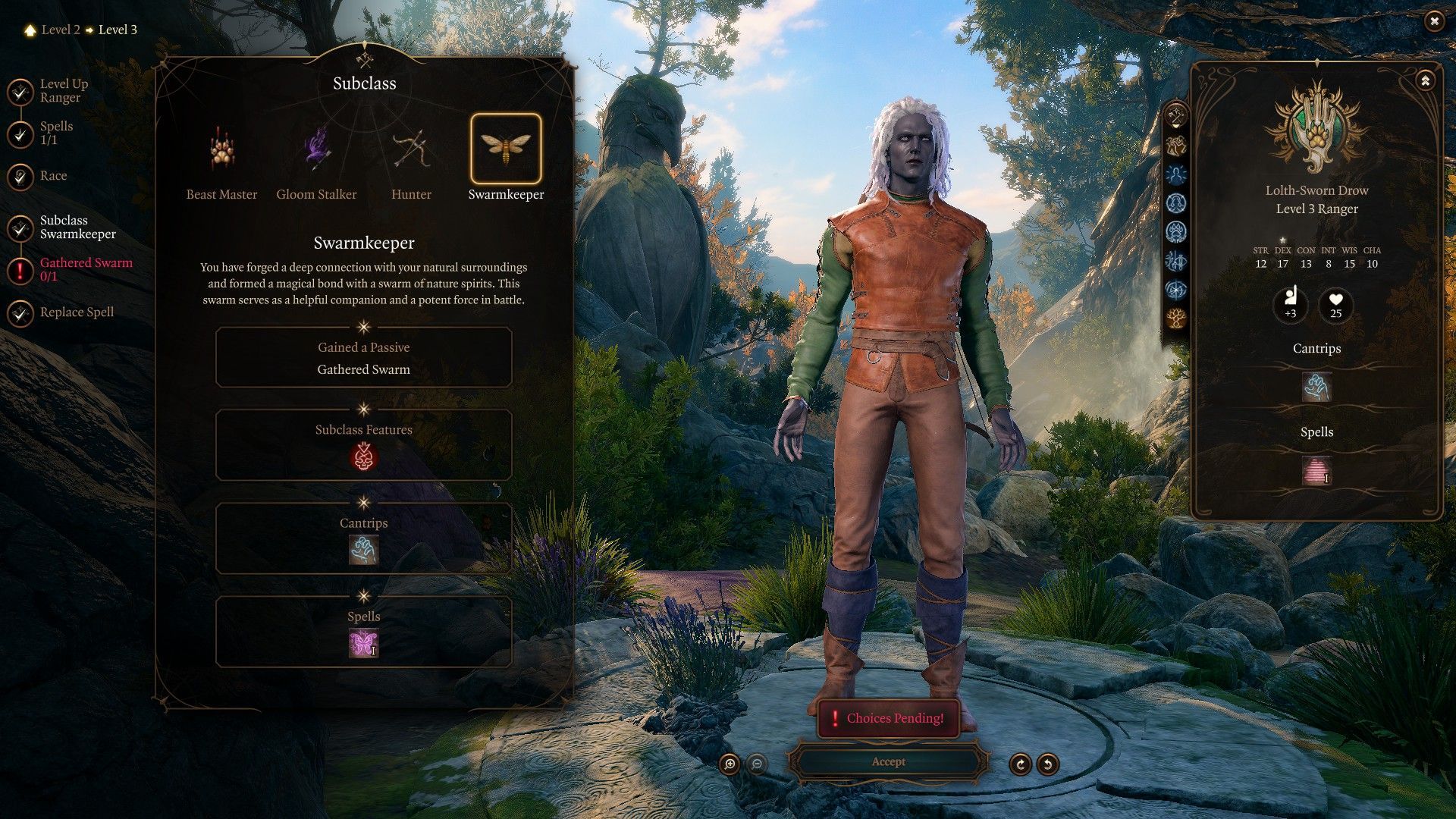
- Swarmkeeper doesn't drastically change the Ranger's gameplay strategy. It puts more emphasis on mobility and the bonus effects received after performing attacks. You can choose this subclass at level 3. As a Swarmkeeper, you're always accompanied by three swarms, and you'll be able to control one of them at a time. Your swarm automatically fights with you, attacking the targets that you focus on. The swarm can increase the damage you deal, impose various effects on enemies, and move you around the map through flying and teleportation.
- As a Ranger, your most important statistics are Dexterity (for weapon attacks) and Wisdom (for spells).
Most important features of this subclass

- At level 3, you unlock Gathered Swarm, which is your key feature. You can choose one of the three available types of swarms, which from now on will always accompany you. You can change the type of swarm each time you level up. Once per turn, after hitting an enemy with an attack, your swarm will help you. You can then choose one of three swarm actions: attack (your attack deals additional 1d6 damage), teleportation (you can teleport a distance of five meters), or special attack (you can apply a debuff assigned to your swarm to the enemy).
- Legion of Bees inflicts Piercing damage and can push enemies back. Cloud of Jellyfish inflicts electrical damage and can Shock the target. Flurry of Moths inflicts Psychic damage and can possibly Blind the target. All three swarms can also teleport you, all within the same distance.
- At level 3, you will also receive the Prey's Scent feature, thanks to which the damage dealt by your swarm is doubled if the target is under the Hunter's Mark spell. You will also learn the Mage Hand and Faerie Fire spells. At level 5, you will also learn the Web spell.
- At level 7, you will unlock the Writhing Tide feature. After using it, it will give you the ability to fly for ten turns, within a range of 9 meters. Surface effects, such as frozen or burning ground, do not affect you either. Writhing Tide requires loads of Writhing Currents. You have three of them and they are renewed during a long rest.
- At level 9, you will learn the Gaseous Form spell, where the number of Writhing Current charges you have will increase to 4.
- At level 11, all swarms will be strengthened. They now deal an additional 1k8 damage. Also, when teleporting, you will receive plus 2 Armor Classes for the rest of the turn. Special attacks of swarms are also enhanced and can now apply two debuffs at once. Jellyfish can stun and disarm, moths can blind and slow down, and bees can knock down and push enemies away from you.
How to play as a Swarmkeeper?
- Playing as a Swarmkeeper doesn't particularly differ from the basic Ranger gameplay. You still mainly rely on ranged attacks, e.g., using crossbows, as well as casting spells. Selecting a swarm is a key choice for a Swarmkeeper player. All swarms are good but they specialize in different aspects, so the choice is entirely up to you.
- The biggest advantage of jellyfish is the type of damage they deal, which is Lightning damage. They are doubled when hitting Wet targets. If you take care of applying the Wet status to enemies before performing this attack and applying the Hunter's Mark as well, the jellyfish will deal gigantic damage.
- The strength of moths lies in the debuffs they impose. Both blinding and slowing down are fantastic debuffs, which, when combined, almost completely disable the enemy from the fight and make them practically defenseless. However, they only last for one turn and will be exhausted at the beginning of the next turn of that enemy, so make sure that the remaining members of your team take advantage of the opportunity you have given them.
- Bees are able to push enemies up to five meters away, which, when combined with often vertical locations and the number of chasms in the game world, can result in very painful falls from heights. Since bees allow you to push enemies away and you don't need high Strength for this, throwing enemies into an abyss becomes extremely easy.
See also



You are not permitted to copy any image, text or info from this page. This site is not associated with and/or endorsed by the developers and the publishers. All logos and images are copyrighted by their respective owners.
Copyright © 2000 - 2026 Webedia Polska SA for gamepressure.com, unofficial game guides, walkthroughs, secrets, game tips, maps & strategies for top games.